
 Aubreigh Lee Daculug
The native approach works like "The Add-On Meter." Every send is a billing event, delivery depends on a service running on your office server, and patient replies aren't assigned to anyone.
Curogram keeps every conversation in one inbox the whole front desk can see and answer.
Curogram clients average confirmation rates above 75%, and Atlas Medical Center cut no-shows from 14.20% to 4.91% in three months.
Four cents sounds insignificant, and nobody at the front desk thinks twice about it during an ordinary morning. Yet Open Dental charges those four cents every time your office sends a patient a text, and the meter never takes a day off.
Every appointment reminder triggers a charge, every friendly "See you tomorrow!" triggers another, and any message longer than 160 characters adds an extra segment fee on top. Across hundreds of patients each month, those small charges become a recurring expense that's easy to overlook.
The larger expense never appears on the invoice, though. It surfaces when a patient answers a reminder with a real question, like "Can I come at 3 instead?", and the reply lands in a mailbox nobody owns. The patient waits, loses patience, and calls, which creates the exact phone call the text was supposed to prevent.
To be fair, Open Dental is a capable, widely respected practice management system. Many offices choose it for its published pricing, its open API, and the simple fact that practices own their data. Texting, however, comes back to you as a metered add-on that depends on a service running on your office server.
This guide explains how HIPAA compliant two-way texting for Open Dental practices works today, what the native tool actually costs, and where it falls short for a busy front office. You'll also see how a single shared inbox changes the daily rhythm for general, pediatric, and orthodontic practices.
We'll be transparent about the trade-offs, too: Open Dental remains your system of record, and nothing in your charts or ledger has to move.
The real question is where patient conversations should live, and whether paying by the message still makes sense when patients simply want a quick answer and your team would gladly take fewer calls.
The Hidden Cost of Open Dental's Texting Add-On
Open Dental gets a lot right. Its fees are published openly, its API is available to developers, and your practice keeps ownership of its data. Those are legitimate reasons offices choose the system and stay with it for years.
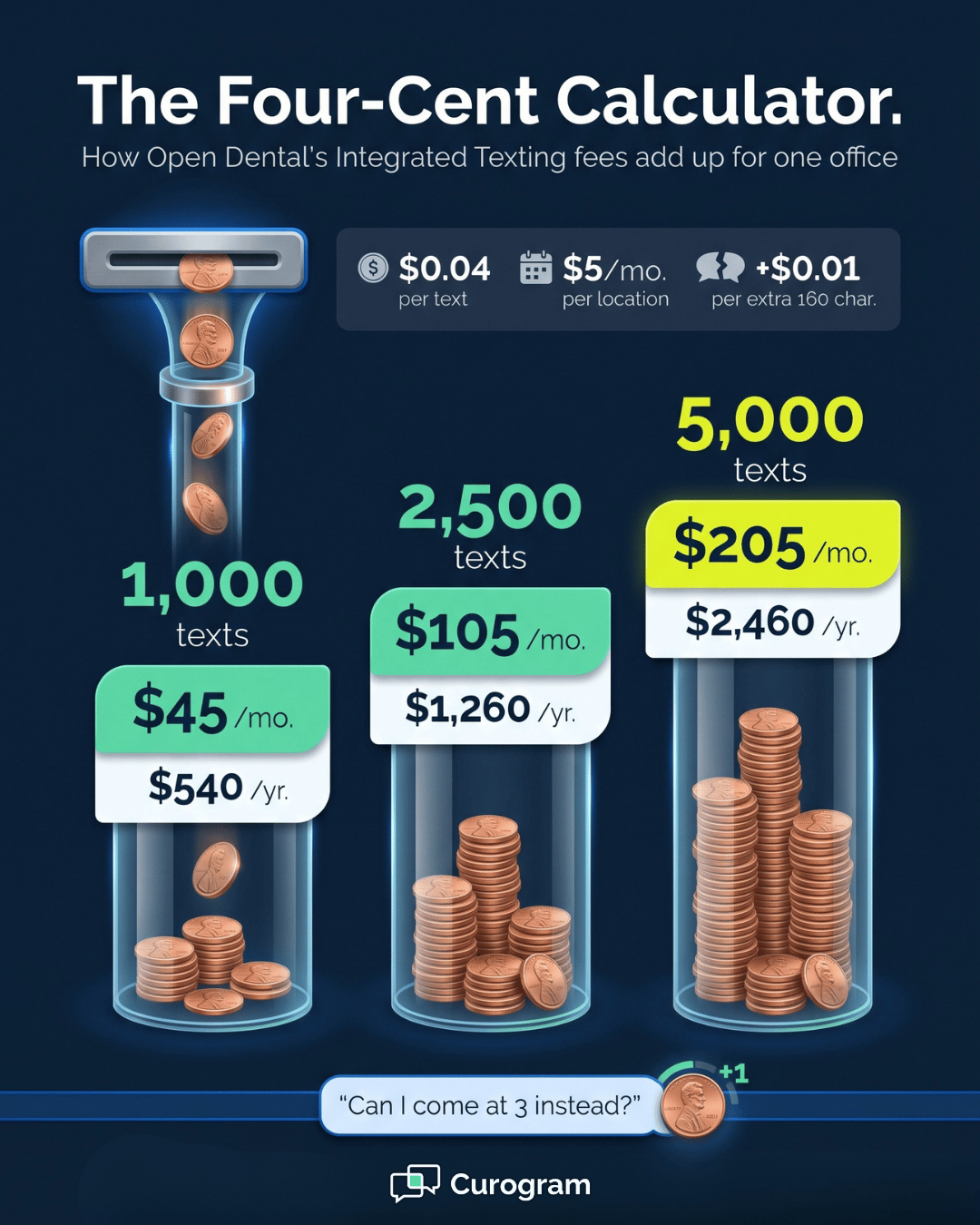
Texting is where the pricing model changes. According to Open Dental's fee schedule, Integrated Texting costs $5 per month per location for an assigned number, or $20 per month for landline texting. Each outgoing message then carries its own separate charge.
So what is the Open Dental texting cost per message?
In the United States, a standard outgoing text costs $0.04, and longer messages add $0.01 for each additional 160-character segment, according to Open Dental's texting Q&A.
Consider an illustrative example with assumed numbers. If your office sends 2,500 outgoing texts a month, including reminders, confirmations, and replies, that equals $100 in message fees plus the $5 access fee. Over a year, the total comes to roughly $1,260 for a single location, before any long messages.
The fee is only half of the problem. Here's how a single patient reply can quietly disappear:
- Your office sends a reminder, and the meter ticks.
- The patient writes back, "Can I come at 3 instead?"
- The reply lands in Open Dental's text mailbox, filed under the patient, but nothing assigns it to a specific team member.
- Whoever notices it first might answer, but on a packed morning, nobody does.
- The patient calls, and because the front desk is busy checking people in, the call rolls to voicemail.
That final step does the most damage. According to Dental Economics, dental practices miss 30–38% of incoming calls during business hours. Meanwhile, only about 14% of new patients leave a voicemail, according to DenteMax.
Every one of those missed calls carries a price. Dental Economics estimates a new patient's first-year value at approximately $850 to $1,300, with lifetime value often reaching $8,000 to $10,000 or more.
There's also a quieter technical risk. Integrated Texting runs through the eConnector, a Windows service installed on your office server, and Open Dental states that this server must remain on at all times for eServices to work.
When the eConnector goes down, texts can stay stuck in "Pending" status, and Open Dental maintains a troubleshooting page for exactly that situation.
Now consider the office manager at the morning huddle, reviewing schedule gaps instead of confirmed patients. She isn't sure whether Monday's reminders actually went out. Meanwhile, the "affordable" system has quietly grown a texting line item that still can't route a reply to the right person.
A Simpler Home for Every Patient Conversation
Curogram is built on an idea Open Dental users already appreciate: one honest price and no lock-in. It serves as an Open Dental Integrated Texting alternative for the conversation itself, while your charts, schedule, and ledger stay exactly where they are.
A flat rate instead of a meter
Curogram doesn't charge per text message. Your team can send the reminder, the follow-up, and the "Sure, 3 o'clock works" reply without watching a counter, which changes how freely staff communicate with patients.
One thread the whole front desk can see
This is what HIPAA texting for dental offices should look like in practice. Every patient conversation sits in one shared inbox, and anyone at the front desk can open a thread, review the full history, and respond from the desktop.
A shared texting inbox for dental front desk teams solves the "who owns this?" problem. A reschedule request no longer sits unread because the person who sent the reminder stepped away for lunch. Someone sees it, and someone answers.
How Curogram works alongside Open Dental
Curogram connects through an integration agent that reads appointment information from your Open Dental database. Setup usually takes two to five days and requires access to the server where Open Dental runs.
Open Dental remains the system of record, and confirmations are tracked in Curogram, because this integration doesn't write appointment status back into Open Dental.
The inbox itself runs in the cloud, so patients can still text and your team can still reply if your server restarts. New appointment updates, however, do depend on that server, since that's where the agent reads them.

Built for the way dental patients communicate
Two-way SMS for dental practices works because it meets patients where they already are. According to Pew Research Center, 98% of U.S. adults own a cellphone and 91% own a smartphone. There's no app to download, no portal, and no login, so patients simply text back.
That approach fits everyday dental life. A parent can confirm a child's sealant appointment from the school pickup line, and an orthodontic patient can ask about a poking wire by text instead of calling after hours. As an Open Dental patient communication platform,
Curogram makes texting feel more personal, not less, because patients receive answers quickly.
For the confirmation side of the workflow, see our guide to automated SMS reminders. When a new patient needs paperwork, the same conversation can deliver secure online forms.
From Ringing Phones to a Quieter Front Desk: The Results
When patient conversations move into one text inbox, the phone line gets noticeably quieter. Curogram client data from clinical settings shows what that change looks like.
| What changed | Result | Source |
|---|---|---|
| No-show rate at Atlas Medical Center | 14.20% down to 4.91% in three months | Curogram case study |
| Compared with the industry | 3X better than the industry average | Curogram case study |
| Appointment confirmations | Above 75% on average | Curogram client data from clinical settings |
| Phone calls | Up to 50% fewer | Curogram client data from clinical settings |
| Staff productivity | 30% or more improvement | Curogram client data from clinical settings |
Atlas Medical Center isn't a dental office, but a no-show creates the same problem whether the empty chair is in a medical exam room or a hygiene operatory. The underlying math works the same way.
Consider another illustrative example with assumed numbers. If a broken hygiene appointment costs your office $300 in production, preventing just ten of them each month protects $3,000. That's exactly the kind of calculation a dentist-owner reviews first.
The larger change is how the workday feels. Routine questions move to text, where your team can handle several conversations in the time a single phone call would take. That frees the phone line for the calls that matter most, especially from new patients.
What Adding Curogram to Open Dental Involves
Moving patient texts into a new inbox sounds like a big project. In practice, the setup is fairly simple.
Here's what your office should plan for before going live:
- Server access: The integration agent needs access to the server that runs your Open Dental database. Have your IT contact on hand during setup.
- Timeline: Setup usually takes two to five days.
- Appointment data: Curogram reads your appointments from Open Dental. That lets reminders and confirmations run from the shared inbox.
- Confirmations: The integration doesn't write appointment status back into Open Dental. Decide who will mark confirmed visits in your schedule.
- Current eServices: Pull your latest Integrated Texting invoice. Use it to compare costs and choose which Open Dental eServices to keep.
A short team meeting before launch also helps. Agree on who checks the inbox at opening, lunch, and closing, so every patient conversation has a clear owner from day one.
Stop Paying by the Text for Conversations That Stall
Open Dental manages your practice operations effectively. It manages your charts, your schedule, and your ledger, and it lets your practice keep ownership of its data. None of that genuinely needs to change.
What needs to change is how patient conversations happen. Currently, many offices pay a fee for every text they send and depend on a server in the back room to keep those messages moving. When a patient replies with a genuine question, there's often no clear owner for the answer.
Curogram handles that part of the workflow. It gives your front desk one shared, HIPAA-compliant inbox for two-way texting, without per-message fees, so your team can reply as often as patients need. Every conversation stays visible to everyone who works the desk.
Consider the partnership this way. Open Dental is designed for your team's work, including charts, schedules, and billing. Curogram is designed for your patients' convenience, offering the quick text that replaces a long phone call, with no four-cent toll on either side.
Those improvements accumulate surprisingly quickly. Fewer calls roll to voicemail, fewer reschedule requests get lost, and fewer chairs sit empty because a simple question never received an answer. Your team recovers valuable time, and patients receive replies while the question still matters.
You don't need to replace anything. Open Dental stays in place, and patients don't install anything, because they simply text your office the same way they text everyone else.
So stop paying by the message for a channel that can't hand off a reply. Instead, see the shared inbox your front desk has been requesting, using your own schedule and call volume.
Schedule a Demo to see how Curogram works alongside Open Dental. Bring your eServices invoice and your busiest day, and in 20 minutes, we'll walk through your numbers together.