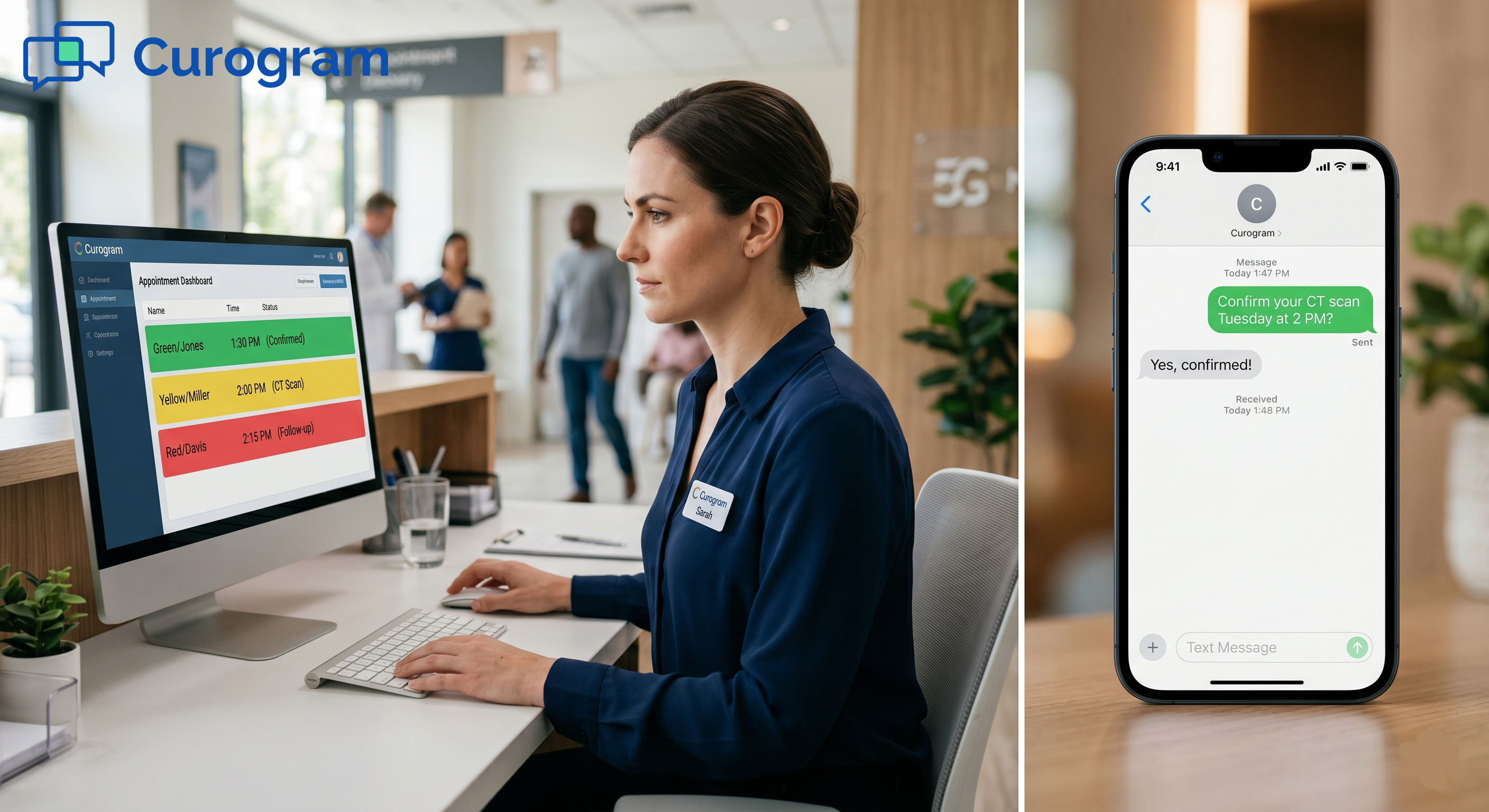

Clients get a two-way text thread on the phone they already carry. No password, no browser, no app. InSync's portal does offer messaging, forms, requests, and payments, but behavioral health portal engagement sits at 15–20%.
Curogram sends plain SMS, which carries a 98% open rate, and sends each reply to intake, billing, clinical, or therapy scheduling. For SUD programs, messaging is 42 CFR Part 2-ready.
Delivery drives results. Atlas Medical Center cut no-shows from 14.20% to 4.91% in three months, based on our internal case data.
An intake coordinator at a 12-provider counseling practice sent the same portal message to a new client three times in four days. No reply came. On day five she picked up the phone. That was the exact call the portal was bought to prevent.
Her portal is doing what it was built to do. InSync messaging is pull-based, so the client has to go get the message. In behavioral health, 15–20% of them do. We call that gap the Portal Paradox, and it lets a practice own a full engagement suite while running its day on voicemail.
Qualifacts built InSync for clinical depth, and it delivers there. You get configurable notes, PHQ-9, GAD-7, and ASAM scoring, and 96% of reviewers praise that setup. Reaching patients is a second job. It needs a second channel.
Our claim, which the rest of this piece proves: a behavioral health patient texting platform running beside InSync out-delivers your portal five times over on day one. Your clinicians keep charting the way they do now. Your front desk stops working every message twice.
Two numbers frame the whole argument. SMS open rates run about 98%. InSync portal engagement in behavioral health runs 15–20%. Same message, same staff, very different odds of arrival.
Ahead: what the Portal Paradox costs a behavioral health or therapy practice each month. Then how a Qualifacts InSync two-way texting integration connects through the FHIR R4 API, and what shifts in the first 90 days.
Owning a Channel Your Patients Never Open
What InSync Does Well, and Where It Stops
Credit where it belongs. InSync notes are configurable down to the assessment level. Scheduling and billing sit in one place. Clinicians who learn it tend to stay.
Patient engagement is where the design shows its age. Portal messaging is browser-based and login-required. There are no native Android or iOS apps, and nothing pushes to a lock screen.
So your practice owns appointment requests, secure messaging, forms, and payments. It reaches only the clients willing to run that gauntlet to use them.
The Pull-Based Loop, Step by Step
Staff sends a portal message. The client must recall a URL, recall a password, and work through a web page to find it. No alert hits their phone. The message ages.
Staff sees no reply and no read receipt, so they cannot tell whether it arrived. Then they dial. That loop runs several times a day in every InSync practice we talk to.
We call the result the Unopened Inbox: about 80% of messages never really arrive, and nobody can prove which 20% did.
What It Costs, by Vertical
Behavioral health carries the cruelest version. Clients managing serious mental illness, active substance use, severe anxiety, or unstable housing face the highest barrier to a portal login.
They also lose the most when contact drops. Missed connections feed no-show rates of 23–50% in the field, worth $15,000–$25,000+ a month at 10–15 providers.
Therapy practices bleed differently. A PT, OT, or SLP patient books 2–3 visits a week across a 6–12 week plan. That cadence runs on fast reschedules. Route it through a portal they forgot exists and visits slip, plans stall, and the authorized episode ends half-finished.
The Version Your Program Director Sees
A program director watches her intake coordinator send one portal message three times, then call anyway. Her front desk fields 80+ calls a day. Every month the practice pays for an engagement suite that 80% of its clients have never opened.

A Second Channel That Leaves Your EHR Alone
The Model Flip
Portals wait. Texts arrive. Moving routine patient messages onto SMS puts them on the one screen a client checks without a credential.
We are not proposing an InSync EHR patient portal alternative that rips anything out. Your portal stays live for the 15–20% who like it, and records, forms, and payments keep working as they do today. What changes is where the other 80% of your conversations happen.
Curogram Highlight: 2-Way HIPAA-Compliant Texting
2-Way HIPAA-Compliant Texting gives your practice a real SMS line, not a blast tool. Clients text back the way they text anyone else. Every reply lands in a department queue: intake, billing, clinical, or therapy scheduling.
The right person answers. Each thread is visible, assignable, logged, and auditable, with read status your portal never gave you.
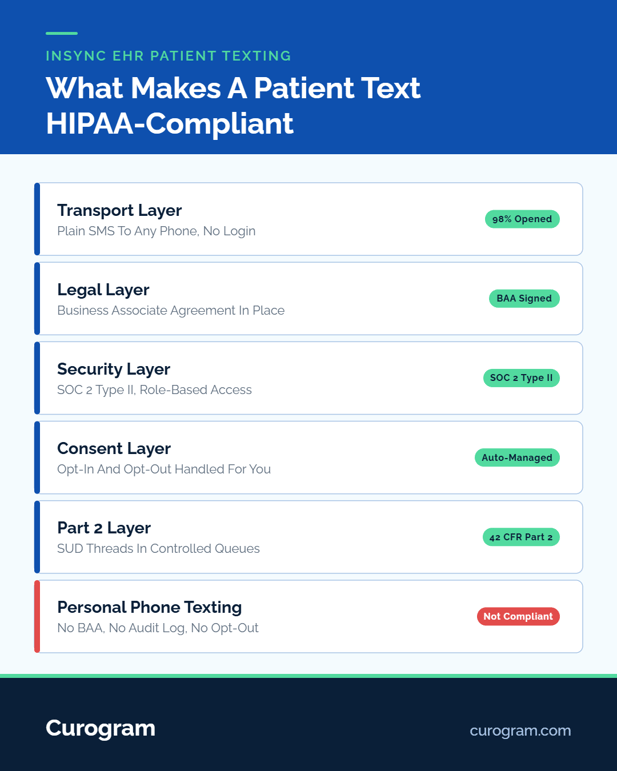
Curogram is HIPAA-compliant and SOC 2 Type II certified. We sign a Business Associate Agreement and handle consent and opt-outs for you.
For addiction treatment teams, messaging is 42 CFR Part 2-ready and built for the 2024 final rule. That makes 42 CFR Part 2 compliant texting for SUD programs a setup choice rather than a custom project.
How the Integration Really Works
Honest version. InSync publishes a documented FHIR R4 API built on Smile CDR, with OAuth 2.0 and SMART App Launch. That beats what most behavioral health EHRs offer.
Setup still involves BAAs with Qualifacts and your practice, sandbox registration, and sign-off from an API coordinator. Curogram's team carries that paperwork. We will not call it plug-and-play.
InSync stays the system of record for charts, notes, and claims, and Curogram runs the conversation. Because Curogram works with any EHR, the text line follows you to Credible or CareLogic.
Where the Qualifacts Stack Stops
Qualifacts iQ handles AI charting and scheduling help. OnCall covers telehealth. Neither one is a texting product, which is why an InSync EHR communication layer has to come from outside the suite.
Two Verticals, One Channel
A client with severe anxiety may never make a phone call. Text is quiet and low-pressure, and each easy touchpoint strengthens the therapeutic bond.
For therapy front desks, SMS communication for PT OT SLP practices matches visit frequency. Quick reschedules, authorization updates, and home-exercise nudges arrive at text speed. Automation lands as more personal here, because patients actually receive it.
The Answered Message: What Changes in 90 Days
The Numbers
Atlas Medical Center went from a 14.20% no-show rate to 4.91% in three months on two-way SMS. That is 3X better than the average it had been measured against.
Across Curogram practices, no-show rates run 53% below industry average, and psychiatry clients average 11.03% against a 23.00% benchmark. Confirmation rates average above 75%. All of these come from our internal client data.
|
Per 100 clients you message |
Through the InSync portal |
Through a direct text line |
|---|---|---|
|
What the client must do first |
Recall URL, recall password, open browser |
Glance at a lock screen |
|
Roughly how many see it |
15–20 |
98 |
|
Can staff confirm delivery? |
No read receipt |
Read status on every thread |
|
Where the reply lands |
One general inbox |
Intake, billing, clinical, or scheduling |
The Shift
Staff stop guessing. Nobody asks whether the portal was checked, because replies show up in a named queue with a timestamp and an owner. Guesswork was the expensive part of the old loop. It turned every message into a message plus a call.
The After Picture
An intake coordinator confirms a new SUD admission by text before lunch. A PT front desk fills a cancelled 3 PM slot in four messages, without leaving the check-in line.
A clinician keeps a fragile client tethered between sessions with a two-line check-in. Your portal keeps serving the minority who prefer it, which was always its best use.
Give Your InSync Practice a Direct Text Line
InSync runs your charting and billing. Curogram runs the conversation: a HIPAA-compliant, Part 2-ready channel that reaches every client, including the ones who never log in.
Think of it as a split by purpose. You chose InSync for your clinicians and the notes they work in all day. A text line serves your clients' convenience. It replaces an unread portal message and the six-minute phone call that follows.
Stop letting the Portal Paradox turn your engagement features back into a phone line.
See How Curogram Works with InSync EHR and Book a Demo. Bring your portal adoption number and your current no-show rate. We will map the text workflow live, against your own queues.
Frequently Asked Questions
Compliance lives in the platform, not the protocol. Curogram runs under a Business Associate Agreement, holds SOC 2 Type II certification, logs every message, manages consent and opt-outs, and controls what PHI moves through a thread.
Clients managing serious mental illness, active substance use, or unstable housing face the highest barrier to remembering credentials and the lowest tolerance for friction. InSync also ships no mobile app, so nothing prompts them.
Part 2-ready messaging keeps addiction treatment threads inside controlled clinical queues with role-based access and full audit logs, aligned to the 2024 final rule. SAMHSA publishes the current rule text for reference.
Curogram's team handles BAAs with Qualifacts, sandbox registration, and API-coordinator sign-off. Your staff supply practice details and sign paperwork. Implementation runs in days, and no IT department is needed.
A billing question, a crisis-adjacent clinical message, and an intake packet chase need different people and different response times. Routing gets each one to a queue where somebody can resolve it.