
8 min read

How Enterprise GE Centricity Teams Deploy Text-to-Pay Across Locations

How Enterprise GE Centricity Teams Deploy Text-to-Pay Across Locations
💡 Text-to-pay deployment for GE Centricity multi-location billing teams replaces fragmented paper workflows with one central platform.

Enterprise practices managing 20 or more sites often juggle separate print runs, mailing schedules, and collection logs per location. This setup caps collections near 20% and burns $16,000 to $20,000 monthly on statements.

Curogram unifies this work into a single dashboard. One admin sets payment rules, timing, and templates for every location from headquarters.

SMS reaches patients on the channel they actually check, which lifts collection rates to 60% to 80% based on Curogram client data from clinical settings. Paper costs drop by 70%, and live integration with GE Centricity rolls out in 2 to 4 weeks.

The result: one platform, full visibility, faster cash flow, and a billing team freed from coordinating 20 separate workflows.

Imagine a billing director on a Monday morning. She manages 20 locations. She has no idea how many statements went out last week, how many got paid, or which sites are falling behind.

This is the daily reality of enterprise billing teams running GE Centricity. Each site prints its own statements. Each site mails on its own schedule. Each site tracks payments in its own Centricity instance. Collections sit stuck near 20%.

Meanwhile, paper costs pile up. A 20-site enterprise can spend $16,000 to $20,000 per month on print and postage. Yet 4 out of 5 patients never engage with the bill.

The fix is not another portal or paper redesign. The fix is reaching patients where they already live, which is text messaging. Text-to-pay shifts the bill from a folded letter to a tap on the phone.

This is where text-to-pay deployment GE Centricity multi-location billing team strategies pay off. One admin runs every site from one dashboard. Payment rules, timing, templates, and reporting all live in one place.

Curogram extends athenaIDX and Centricity to the patient layer. It does not replace either system. Instead, it closes the gap between back-office RCM and patient-facing collections.

In this guide, we walk through the villain (the Statement Factory), the fix (a centralized collections platform), the results enterprise teams see, and how to plan a smooth rollout.

Each section builds toward one goal: turning fragmented paperwork into a unified billing operation. 

The Villain: The Statement Factory

Most enterprise billing teams do not have a tech problem. They have a coordination problem.

Paper has shaped every workflow, and that shape does not scale past 15 to 20 sites. Below are the four pressures that define the Statement Factory.

The Coordination Chaos

Each site runs its own statement process. Each has its own printer, postage budget, and mailing schedule. Collection logs live in 20 separate Centricity instances.

The billing director cannot answer simple questions. How many statements went out from Location A this week? Why is Location C trailing Location D? Who owns a drop in collection rate?

Coordination eats most of the team's time. Visibility is thin. Past 20 sites, the model breaks.

Why Manual Tracking Fails at Scale

Billing teams resort to spreadsheets and weekly status calls. Each leader sends in numbers by Friday. By Monday, the data is already stale.

With 20 sites and 200,000 patients, even small reporting gaps hide big revenue shifts. A 5% drop at one site can cost thousands per month before anyone spots it.

The Multi-System Burden

Centricity runs the clinical side. athenaIDX handles enterprise RCM. Neither tool is built for multi-location patient collections visibility.

Billing leaders end up doing manual rollups across both systems. Every chart, every metric, every board slide takes hours of human work that the systems were never meant to do for them.

The Location Inconsistency

Each site prints its own statements, so each site sends a slightly different one. Timing varies. Format varies. Payment instructions vary.

Patients at Location A may get a clean, modern statement with a payment portal. Patients at Location B may get an outdated note with only a phone number. The brand feels broken from the outside.

This is the hidden cost of fragmented billing workflow GE Centricity SMS integration efforts that never got built. Without unified rails, every site reinvents the wheel.

The Cost Scale

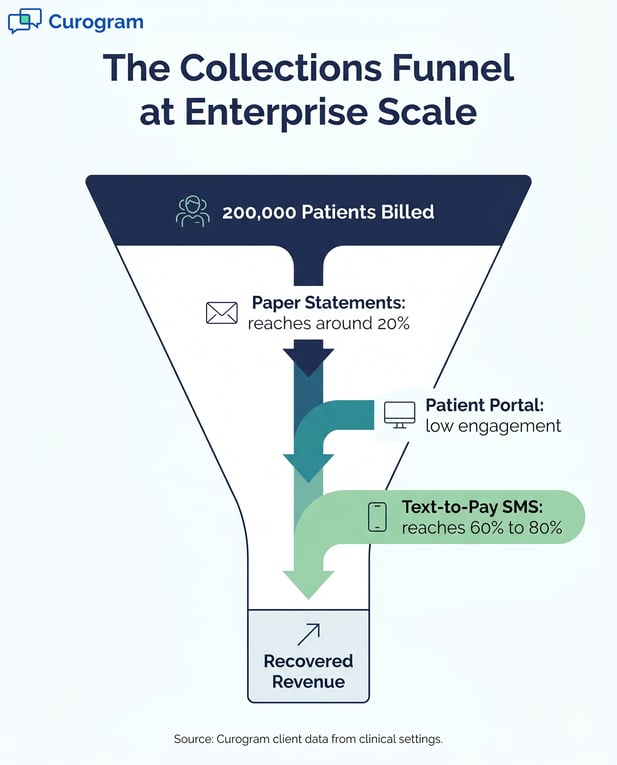
Paper statement costs run $800 to $1,000 per site per month. Across 20 sites, that is $16,000 to $20,000 every month. Yet 80% of those statements go ignored.

The enterprise pays full price for a channel that reaches 1 in 5 patients. The other 4 stay silent because the bill never landed on a channel they actually use. 


Infographic showing the collections funnel at enterprise scale with text-to-pay reaching most patients

The Guide: The Centralized Collections Platform

Solving the Statement Factory needs more than a new tool. It needs a new operating model. Curogram acts as the centralized collections platform that sits next to Centricity and athenaIDX, not on top of them.

One Dashboard, All Locations

A single admin sets the rules for every site from one console. Payment templates can be uniform across sites or tuned per location.

Payment rules trigger SMS at the right moment, such as 2 days after billing, with a follow-up if no reply is received within 7 days.

Send timing can match patient behavior. Many practices text at 2 PM local time, when reply rates run highest. All 20 sites inherit the same logic without site-by-site setup.

From Headquarters, Not From Each Site

Staff at each location keep their normal workflow. They do not need to learn a new tool or change daily habits. SMS runs in the background once the admin configures the rules.

This frees site managers to focus on clinical operations. The corporate billing office keeps full control of the patient payment flow.

Built-In Patient Consent and Opt-Outs

Curogram handles TCPA compliance, opt-outs, and consent at the system level. If a patient opts out at one location, that choice flows to every site by default.

This means one unified compliance posture across 20+ sites. No site-level loopholes, no manual cleanup, no risk of accidental over-messaging.

Centralized Collections Dashboard Centricity Reporting

The enterprise collections dashboard pulls every site into one view. Leaders see total statements sent, SMS engagements, payments received, payment rate, and average time-to-payment.

Drill-down works at the location level. If Location A is hitting 75% and Location C is at 55%, the billing director can dig into why. Best practices spread faster because the data finally exists in one place.

This is what enterprise collections reporting Centricity text-to-pay looks like in practice. No spreadsheets, no Monday rollups, no guesswork.

Compliance and Control That Travels With the Patient

Curogram tracks patient preferences across the network. If a patient prefers SMS at Location A but paper at Location B, the system honors both.

Multi-location payment management healthcare workflows need this kind of patient-level memory. It protects trust at scale and keeps the legal posture clean.

The Success: The Unified Collections Operation

Once the platform is live, the numbers tell a clean story. The shift is not just technical. It changes how the billing team works, what they focus on, and how leadership sees the operation.

The Core Metrics That Move

Curogram client data from clinical settings shows multi-location practices lifting collections from around 20% to 60% to 80%. Paper costs fall from $16,000 to $20,000 per month down to under $5,000, a 70% drop.

Time-to-payment also drops sharply. SMS arrives in seconds, not the 5 to 7 days that paper needs. Days in A/R fall, and cash flow improves.

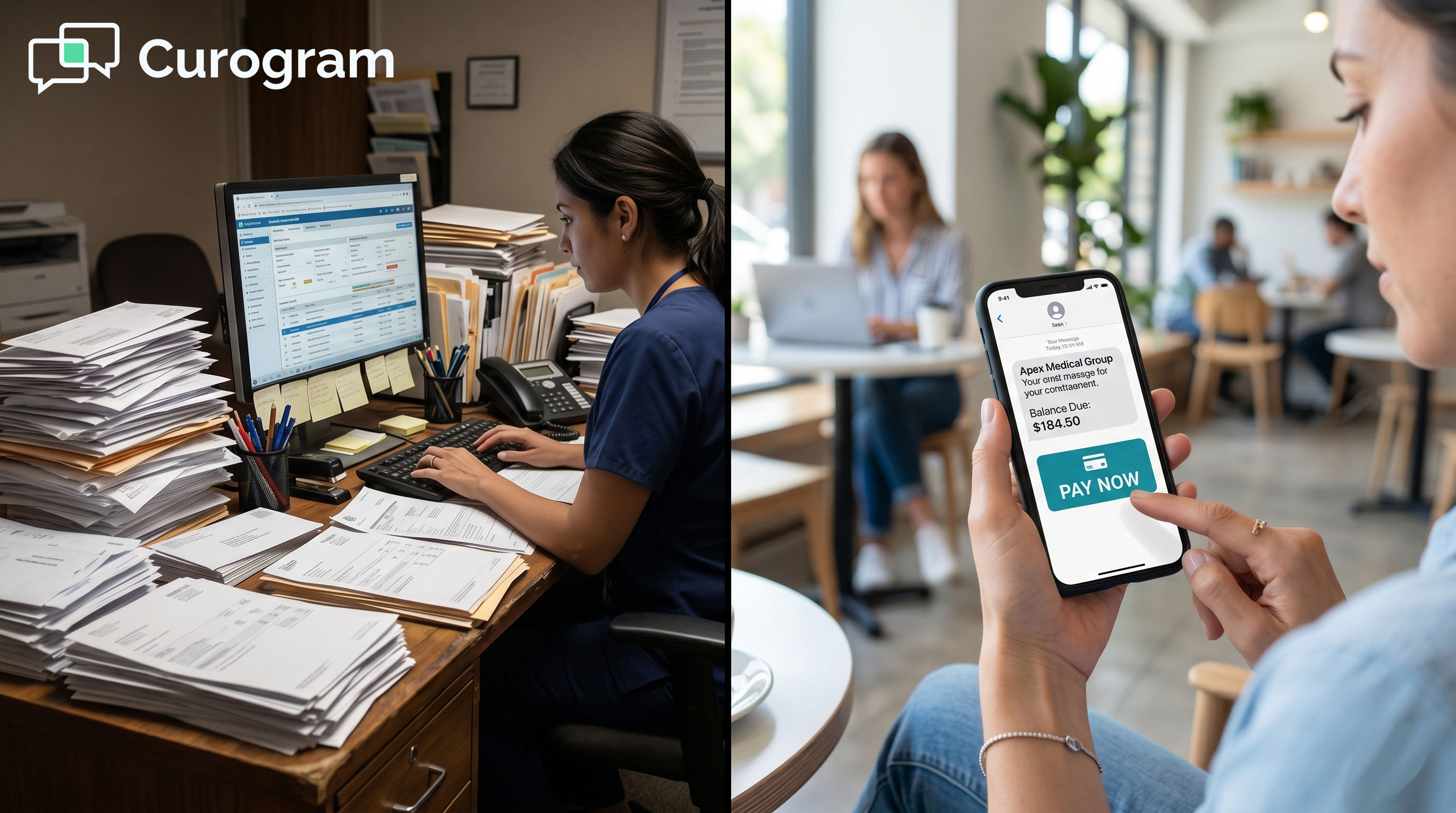
Below is a side-by-side view of the shift.

Workflow Element

Old Paper-Based Model

Centralized Text-to-Pay

Collection rate

Around 20%

60% to 80%

Monthly statement cost (20 sites)

$16,000 to $20,000

Less than $5,000

Visibility

Per-location silos

One real-time dashboard

Admin workload

20 separate workflows

One unified workflow

Deployment timeline

Site by site, months

2 to 4 weeks


From Location Silos to Enterprise Collections

Before the shift, the billing director ran 20 mini-operations. After, she runs one. The dashboard answers questions in real time that used to take a week of phone calls.

This is the heart of a centralized collections dashboard Centricity setup. Leaders gain visibility they never had before, and frontline staff stop chasing paper trails.

What Billing Teams Do With the Freed Time

Time that used to go to coordination now goes to higher-value work. Teams focus on payer disputes, contract negotiations, and exception handling. The strategic side of the revenue cycle finally gets attention.

Front desk staff also stop fielding as many billing calls. Patients pay from the SMS link before they ever pick up the phone, so call volume falls along with statement volume.

The Cash Flow Outcome

Faster collections mean tighter cash flow cycles. A 3 to 4x lift in collection velocity adds up fast across a 200,000-patient base.

For CFOs, this is the clearest line: lower print costs, higher recovery, and shorter A/R aging. The math holds even before factoring in soft gains like staff retention and patient satisfaction.

Why the Operation Feels Different

The mood inside the billing office shifts. Less firefighting, more strategy. Staff feel like operators of a system, not chasers of paper.

Patients feel the change too. They get a clear, mobile-friendly bill, pay in a few taps, and move on with their day.


Deployment and Rollout Strategy

A smooth rollout follows a simple pattern: pilot small, prove value, then scale. Most enterprises move from kickoff to full deployment in 6 to 8 weeks. Below is how the phases break down.

The Pilot Approach

Most practices start with 2 to 3 sites. The pilot proves ROI before broader rollout. Within 4 to 6 weeks, leadership can see collection rate lift and cost savings in real numbers.

Pilot sites often volunteer based on pain. A site with a stuck collection rate or high paper cost is a strong candidate. The win there builds buy-in across the network.

How to Pick Pilot Locations

Choose sites that mirror the broader network. Mix one high-performer and one struggler. The contrast makes the platform's impact clear to skeptics.

Avoid sites in the middle of a major system change or staffing gap. Pilot success depends on focus, not noise.

Measuring Pilot Success

Track three numbers: collection rate, paper cost per site, and time-to-payment. If all three move in the right direction within 30 days, the pilot has done its job.

Share the data widely. Honest numbers from a real site beat any vendor pitch when leadership debates the broader rollout.

Staff Text-to-Pay Training Healthcare Billing

Curogram's admin console is built for billing staff, not IT teams. One admin can learn the platform in 2 to 3 hours.

Site staff do not need new training. SMS runs automatically once rules are set. Front desk teams may field a few new patient questions, but the scripts are short and intuitive.

Solid staff text-to-pay training healthcare billing programs focus the admin on three things: template editing, rule logic, and reading the dashboard. Everything else is optional.

The Timeline From Kickoff to Full Network

Curogram's live GE Centricity integration deploys in 2 to 4 weeks. Pilot at Location A starts in Week 1. Rollout to the rest of the network typically runs through Weeks 4 to 8.

Most enterprises hit full deployment before the next quarterly board meeting. That makes the ROI story easy to share at the next leadership review.

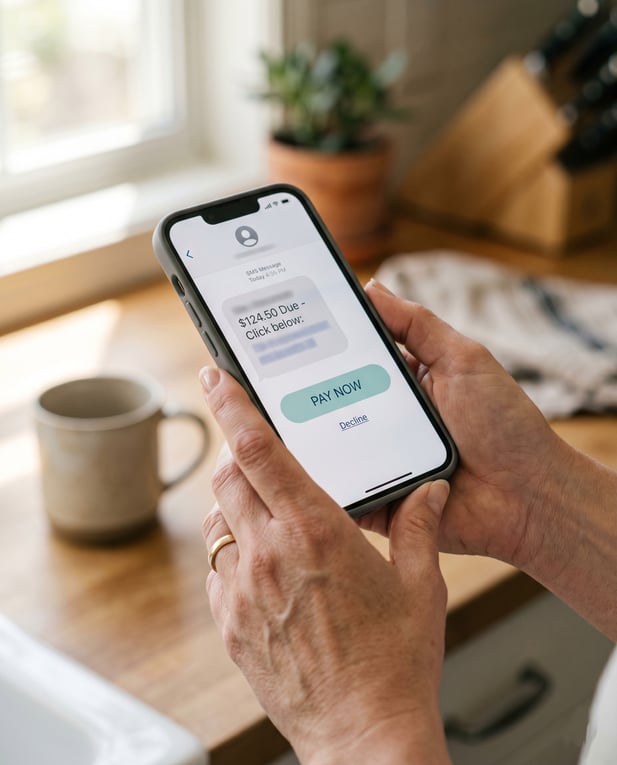
Smartphone showing a payment message

Conclusion

The Statement Factory is not a software problem. It is a coordination problem dressed up as paper. Once enterprise billing teams see this, the fix becomes clear.

Centricity runs the clinical operation. athenaIDX runs the enterprise RCM. Neither was built to chase patients across 20 sites. That gap is exactly where text-to-pay fits.

With Curogram, one admin runs every site from one dashboard. Payment rules, timing, templates, and reporting all live in one place. The result is a unified operation instead of a tangle of silos.

The numbers speak for themselves. Collection rates climb from 20% to the 60% to 80% range. Paper costs drop by 70%. Time-to-payment falls from days to seconds.

More importantly, the billing team gets its time back. Less coordination, more strategy. Less firefighting, more leadership.

How much time does your billing team spend coordinating paper statements across 20 or more sites?

If the honest answer is too much, the next step is a short conversation. We will review your current multi-location workflow, model the cost savings from cutting paper volume, and project the collection lift based on the 20% to 60% to 80% benchmark.

Schedule your demo today. In one call, we will map out your rollout plan and show you exactly what your enterprise can recover in the first 90 days.


Frequently Asked Questions

How does text-to-pay work alongside our existing GE Centricity and athenaIDX setup?

Curogram sits next to both systems, not on top of them. It pulls patient balance data through a live integration with Centricity. athenaIDX keeps handling enterprise RCM, while Curogram extends the workflow to the patient phone through SMS payment links.

How can we control payment timing across different locations?

Each site can set its own SMS send time. Some prefer to text right after billing, while others wait 2 days. The admin sets defaults at the enterprise level and can override them per site for unique patient demographics.


Why should we centralize collections instead of letting each site manage its own?

Site-level control sounds flexible, but it caps visibility and consistency. Centralizing gives leadership one dashboard, one compliance posture, and one source of truth. Local flexibility still lives inside the central platform through per-site rule overrides.

How fast can a 20-site enterprise actually go live?

Most enterprises pilot in 2 to 4 weeks and finish full rollout within 6 to 8 weeks. The live GE Centricity integration removes most of the typical IT lift. The pace depends mostly on internal pilot review cycles, not on the platform itself.


Why do patients respond to SMS when they ignore portals and paper?

Patients check text messages within minutes, but they rarely log into portals or open paper mail. Text-to-pay meets them where they already pay attention. The friction of remembering a portal login or finding a paper bill simply disappears.