
7 min read

Text-to-Pay Billing for CharmHealth Practices

Text-to-Pay Billing for CharmHealth Practices
💡 Text-to-pay billing for CharmHealth practices replacing paper statements is the fastest way to get paid. Curogram sends a secure payment link by text. Patients tap it and pay in seconds, with no portal login and no app to download.        

CharmHealth processes cards through Bluefin but has no built-in text-to-pay. Paper statements cost $800–$1,000 a month and collect on only about 20% of balances.

Texts see roughly 98% open rates. So the bill lands where patients already read, balances clear the same day, and your front desk stops chasing payments by phone.


Your practice did the work. The visit happened, the care was good, and the charge is sitting in CharmHealth, ready to collect. Then the bill goes out, and nothing comes back.

That gap between earning money and actually getting it is where many practices quietly lose ground. You print the statement. You mail it. The envelope lands on a kitchen counter and disappears under everything else.

It sounds like a small problem. It isn't.

Here's the part that stings: CharmHealth bills through its portal and processes cards through Bluefin, yet a strong CharmHealth integration adds the one capability it lacks on its own — a way for patients to settle balances directly by text.

The processing is genuine and the portal works. The problem is that patients rarely use either one.

Paper statements run most practices $800–$1,000 a month, yet they collect on only about 20% of everything mailed. So you spend more to recover less, every single cycle. For a practice tracking every dollar, that is money already earned sitting frustratingly out of reach.

Why does paper keep failing?

Because it asks the patient to do extra, inconvenient work. Find the envelope, write the check, buy a stamp, or recall a portal password they abandoned months ago.

Most people simply won't bother. The faster route lives somewhere far more familiar — the text thread your patients glance at throughout the day.

This guide explains why paper billing keeps underperforming, how SMS patient payments for CharmHealth actually function, and what genuinely changes when the bill arrives somewhere people are willing to pay it. You'll find real numbers, plain explanations, and zero fluff throughout.

No brand-new EHR. No torn-out workflow.

Just a smarter destination for the bill, and a noticeably faster, friendlier way to collect what your practice is already owed.

Paper Billing Costs More and Collects Less

Let's start with what's actually happening when a balance goes unpaid. Two simple breakdowns explain the whole problem.

The Loop That Never Closes

CharmHealth processes payments through Bluefin and bills through its portal. That's real, working capability. But the only two ways a patient can settle up are logging into the portal or paying a paper statement.

So here's the loop.

The practice prints and mails the statement.

The patient sets the envelope aside, and the portal invite goes unopened.

Then staff follow up by phone, and the entire cycle simply repeats itself. Each additional step introduces more delay, and delay is precisely where collectable revenue quietly slips away.

The Math That Doesn't Add Up

Now put real numbers on it.

What you spend or get The number
Monthly cost of paper statements $800–$1,000
Collection rate on those statements ~20%
What it adds up to Full price to recover one in five bills

Read that table again. You're spending up to $1,000 a month to collect on roughly one out of every five statements. That's the bottleneck — more spent to recover less, every single cycle.

For a budget-conscious practice, this isn't an accounting detail. It's watching money you already earned sit uncollected because paying it felt like a hassle. And that hassle is the whole problem: every step you put between the bill and the payment is a step where patients quietly drop off.

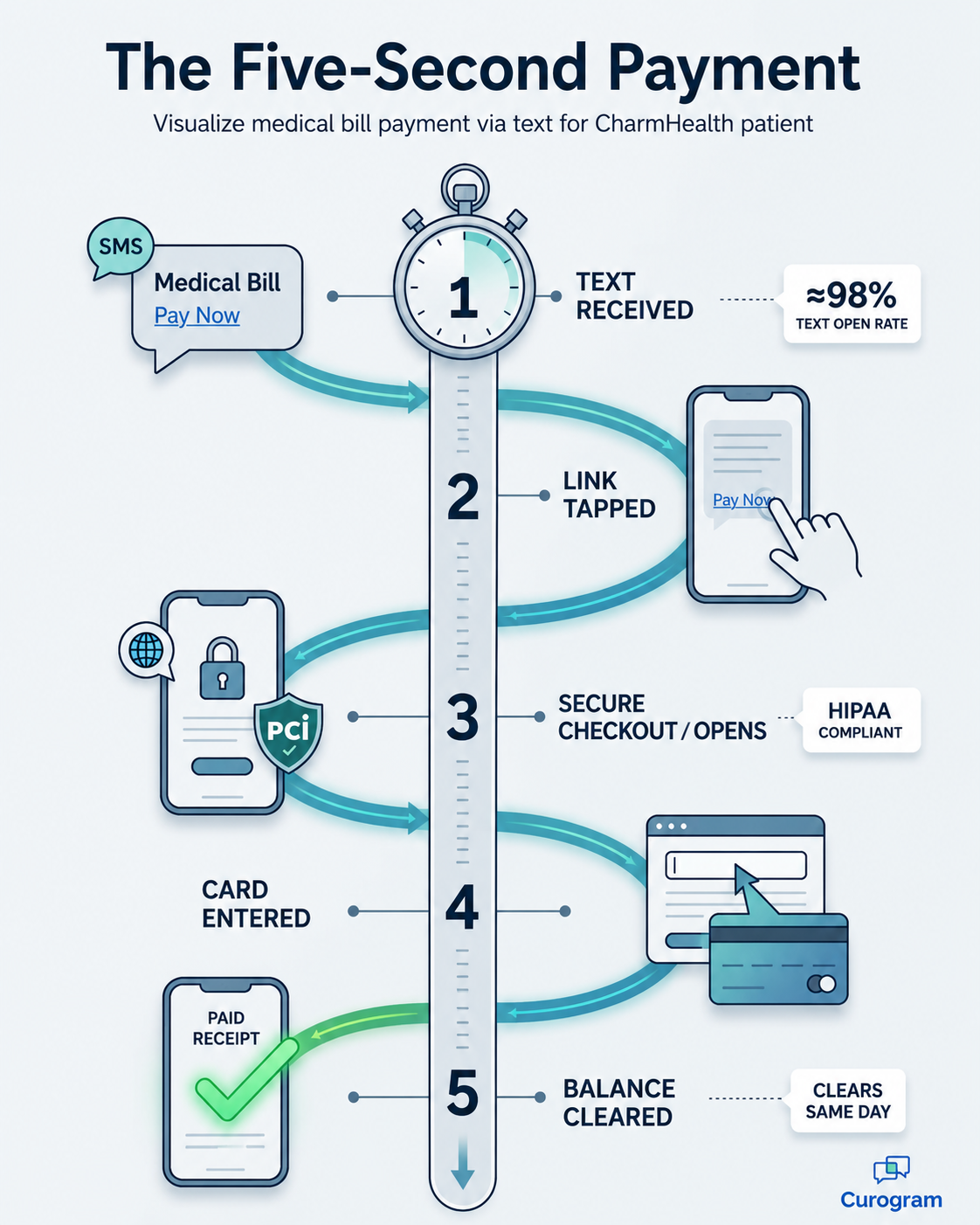
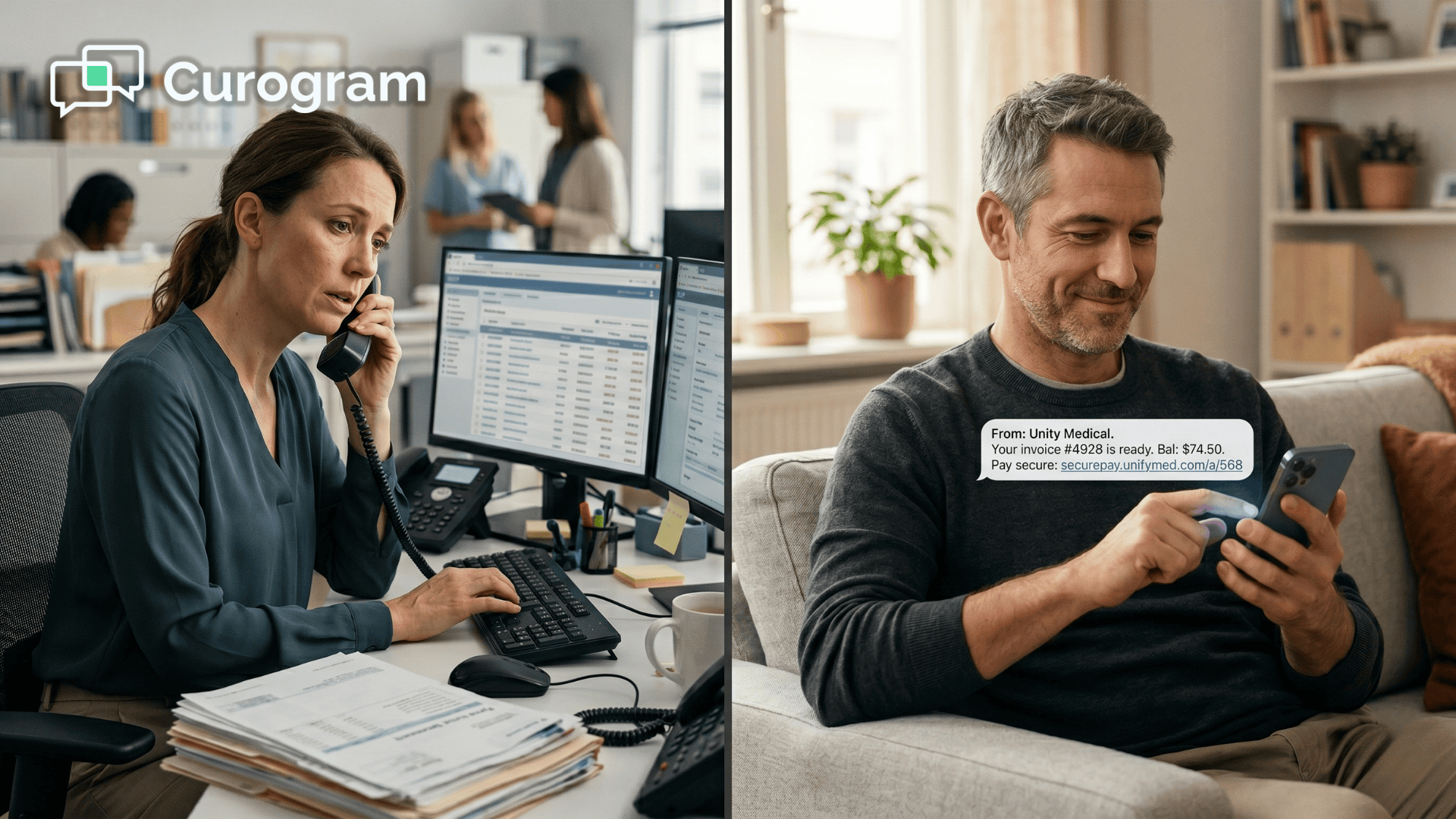
Infographic of a five-second text-to-pay payment flow for CharmHealth practices

How Text-to-Pay Turns a Balance Into a Tap

Now the better path. Curogram works as the cash-flow engine — it sends a secure payment link by text that a patient can pay in one tap.

This is CharmHealth text-to-pay through Curogram:

A CharmHealth patient billing alternative that doesn't replace anything you already use. It simply adds a faster channel on top of what's there.

Here's how SMS patient payments for CharmHealth actually work:

  • A balance is ready in CharmHealth, processed as always through Bluefin.
  • Curogram sends the patient a secure payment link by text.
  • The patient taps the link, with no portal login and no app to download.
  • They pay on a secure, PCI-compliant checkout page.
  • The balance clears, often the same day.

That's the entire flow. No envelopes, no password resets, no phone tag.

Because it runs alongside CharmHealth and its Bluefin processing, text-to-pay adds a payment option without touching your EHR or your gateway. You keep your setup, and patients just get an easier way to pay.

For a practice tracking every dollar, this is found money. You're not chasing new revenue — you're finally collecting balances you already earned.

The ability to collect copays by text means fewer write-offs and faster cash, with no new overhead to manage.

Want patients reminded before the bill even arrives?

Pairing text-to-pay with automated SMS reminders keeps balances small and expected.

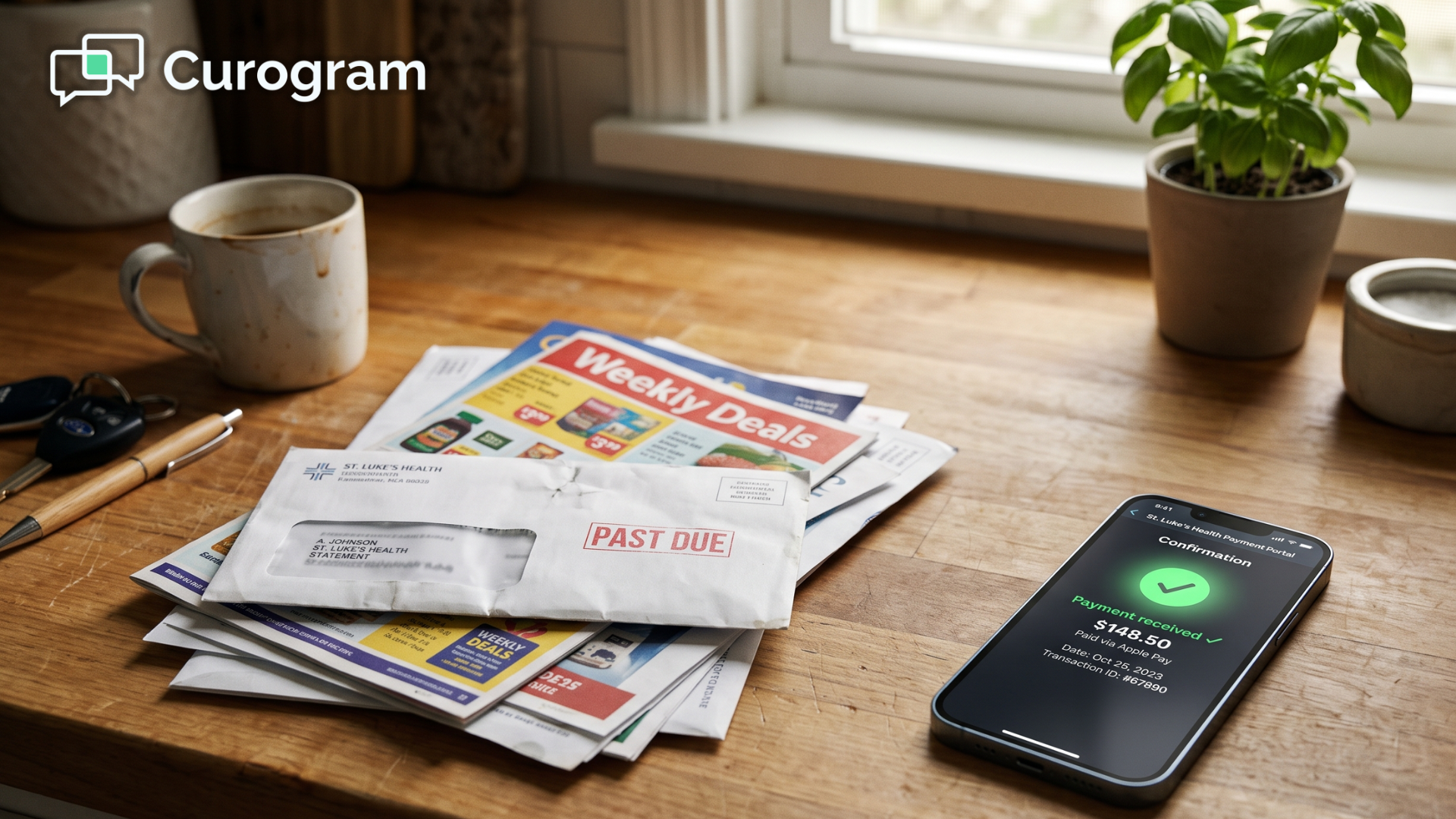
Patient at home relaxed after paying a medical bill by text, phone on the table

What Changes When the Bill Pays Itself

So what does this do for your numbers? Let's translate it into real impact.

Text messages reach patients at roughly 98% open rates. Portal engagement often sits in the single digits. When the bill lands in a channel people actually open, more of them pay, and they pay sooner.

A one-tap link is built to beat the ~20% collection rate of paper. Even a modest lift matters here.

Picture a practice that sends $1,000 in statements and collects 20% today. That's $200 recovered. Push collection to 50%, and that's $500 — an extra $300 a month, or about $3,600 a year, on the very same balances.

At the same time, you remove the $800–$1,000 a month you were spending on paper and postage. So you collect more and spend less, in the same motion.

The bill arrives where patients already pay. That's the shift — the self-paying statement.

This is what faster patient payments look like for a medical practice that's tired of the chase.

The day-to-day change shows up in three places:

  • Balances clear the same day, not weeks later.
  • Paper and postage costs steadily drop.
  • Staff stop working the phones for money that should arrive on its own.

When you replace paper statements, healthcare billing stops resembling collections entirely. Instead, it becomes a quick, considerate reminder that patients genuinely appreciate and respond to.

Where Text-to-Pay Fits in Your Billing Day

By now the payoff is clear. The practical question is simpler: where does this actually live in your day? Good news — it slides into the routine you already have.

It Adds a Channel, Not a Project

There's no rip-and-replace here. Text-to-pay sits on top of CharmHealth and Bluefin, so your billing setup stays exactly where it is. Your team learns one new habit: send the link instead of the statement.

That's the whole change. No data migration, no months-long rollout, no retraining on an unfamiliar system. Staff who can send a text can run it on day one.

It Covers the Whole Billing Cycle

A payment link isn't only for leftover balances. You can collect copays by text before a visit, send the link the moment a claim clears, and follow up on aging balances without a single phone call.

So the same tool works at three points in the cycle:

Up front, right after, and weeks later. Each one is a place where paper used to stall and now doesn't.

One channel, the entire arc of a bill.

It Grows With You

Sending a payment link takes seconds. Mailing a statement or working the phones takes minutes — and those minutes multiply with every patient.

Picture a front desk handling 200 balances a month.

Trim even three minutes of follow-up off each one, and that's roughly 10 hours back every month — time your team can spend on patients instead of postage. As volume climbs, text-to-pay scales with it while paper only gets heavier.

The takeaway is that this accommodates the practice you actually run today, not some idealized version of it. You don't reorganize your established workflow around the tool. Instead, the tool quietly reshapes itself around your existing routine.

Send the Bill Somewhere People Will Pay It

Here's the simple truth underneath all of this. Text-to-pay doesn't replace CharmHealth's clinical work or its Bluefin processing. It only changes where the bill goes — from an envelope or a forgotten portal to the text thread your patients already read.

Think about the two systems working side by side.

CharmHealth records your charges. Curogram makes their payment effortless. One holds the clinical and financial data, and the other quietly handles getting you paid.

That division of labor is the entire point. You don't rip anything out, retrain staff on an unfamiliar EHR, or change how Bluefin handles cards. You simply add one channel, and it happens to be the channel people genuinely use.

Now weigh the cost of doing nothing. Every paper statement you mail is an expense that mostly never gets paid. You front the printing, the postage, and the staff time, then recover on roughly one in five.

That isn't really a billing system. It's a slow, quietly predictable leak. Switching billing to text finally closes it.

Balances clear faster, paper costs fall away, and your front desk reclaims hours every single week. Eliminating $800–$1,000 a month in paper while collecting sooner often covers the platform entirely on its own.

So the math tends to work in your favor before you've even counted the goodwill from patients who'd far rather tap a link than dig out a checkbook and a stamp.

The next step is straightforward. Schedule a Demo, and we'll show you an actual payment link going out by text in real time, start to finish, exactly as your patients would experience it.


Frequently Asked Questions

Is text-to-pay secure and compliant?

Yes — payments run through a secure, PCI-compliant checkout, so no card data ever travels inside the text itself. Curogram is also HIPAA-compliant under a signed BAA. Patients get a fast, easy way to pay while the transaction stays protected. You can review these requirements through the PCI Security Standards Council.

Does this replace CharmHealth's billing or its Bluefin processing?

No. Curogram adds an SMS payment channel alongside CharmHealth and its existing gateway. You keep your current billing setup and simply give patients a faster way to pay. Nothing about your EHR or your Bluefin processing changes.

What about patients who don't use a smartphone?

They're still covered. The portal and paper options stay available for anyone who needs them. Text-to-pay just becomes the easy default for everyone who can use it, so no one gets left out.

How quickly can our practice start collecting by text?

Most practices can begin sending payment links soon after setup, since text-to-pay layers on top of your existing CharmHealth and Bluefin tools. There's no long migration and no new EHR to learn. Your team keeps working the way it already does.

Will patients really pay faster with a text link?

In most cases, yes. Texts see roughly 98% open rates, while portal messages often go unread. A bill that lands where people already look, and clears in one tap, removes the friction that keeps paper statements sitting unpaid.


Pay by Text, Not Portal Login | CharmHealth Billing

Pay by Text, Not Portal Login | CharmHealth Billing

💡 Text payment links for CharmHealth patients without portal login get paid because they strip out the friction that stalls every other method. A...
Read More
Text-to-Pay for Veradigm EHR | Collect Balances Without the Portal

Text-to-Pay for Veradigm EHR | Collect Balances Without the Portal

💡 Veradigm EHR practices lose revenue when payment options live behind a portal login. FollowMyHealth offers mobile check-in and payment tools,...

Read More
NextGen Text-to-Pay | SMS Payment Links That Replace Paper Statements

NextGen Text-to-Pay | SMS Payment Links That Replace Paper Statements

💡 NextGen Enterprise text-to-pay powered by Curogram sends patients a secure SMS payment link immediately after their visit. There is no portal...

Read More