
 Jo Galvez
An REH runs an ED, observation care and the outpatient services it picks. Its average stay per patient must stay at 24 hours or less across the year.
Patients who need longer care move to another hospital. Medicare pays the REH the outpatient rate plus 5%, and a monthly payment.
So follow-up texts, transfer check-ins and recall by service line belong in conversion planning. Curogram, Azalea Health's patient engagement partner, runs that outreach for REHs on Azalea Health.
A Rural Emergency Hospital can't provide acute inpatient care. Every patient who needs sustained care gets transferred out, and every patient it keeps is an outpatient it has to be able to reach later.
That makes rural emergency hospital patient communication, REH conversion plans included, a structural question for any CAH weighing the switch.
Most conversion checklists cover staffing, licensing, the transfer agreement and the payment model. Patient contact rarely makes the list, because a CAH never had to plan for it.
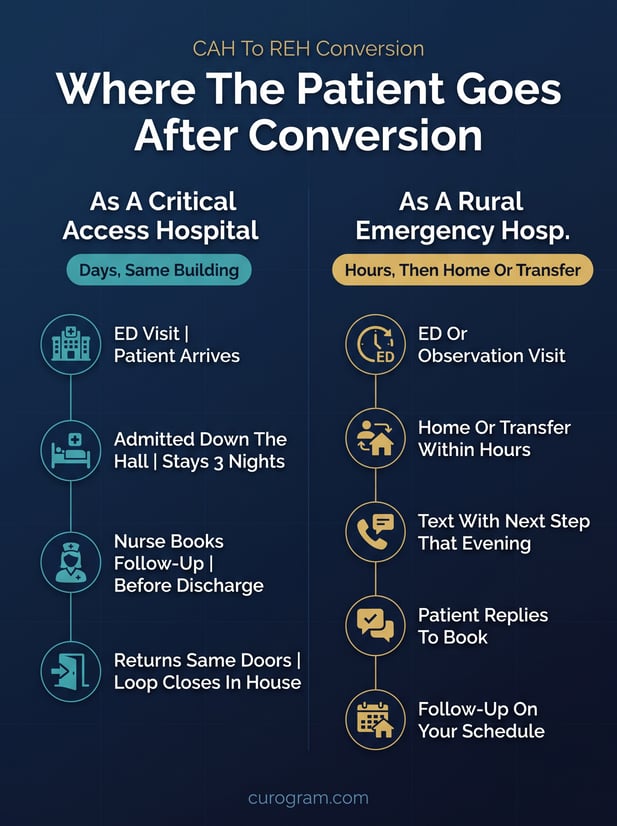
Inpatients came back through the same doors, and the nurse who discharged them often booked the follow-up herself.
After conversion, that loop breaks. The patients who would have stayed three nights now leave by ambulance. The ones who stay leave within hours.
Both groups need a next step, and both are now the outpatient side's job to reach. In most small hospitals, that side is a front desk of two or three people who already answer every phone line.
One rule shapes all of it. An REH must keep an annual per-patient average length of stay of 24 hours. That's an average across a year of patients, so a single patient who waits 30 hours for a transfer bed doesn't break it.
Below, we'll walk through why the REH model depends on outpatient reach, what conversion changes about patient contact, and which communication pieces to set up before your effective date.
Curogram, Azalea Health's patient engagement partner, runs that outreach for hospitals on Azalea Health, and we'll show where it fits.
Why an REH Depends on Outpatient Reach
The 24-hour annual average, stated correctly
The definition sits in 42 CFR Part 485, Subpart E. An REH provides emergency services, observation care and any outpatient services it elects, with an annual per-patient average length of stay of 24 hours or less.
Read that rural emergency hospital 24 hour average length of stay rule as written. Each stay runs from registration, check-in or triage, whichever comes first, to discharge. Then the stays are averaged across the year. Observation hours count toward the stay, so a patient held overnight for chest pain adds to the average like any other.
What a long hold does and doesn't do
A chest pain patient held 30 hours while you wait on a cardiac bed in the city doesn't put you out of compliance. A pattern of long holds would push the average up over time, so track it monthly.
If you see the rule written as a hard cap on each patient, check the source before you build policy on it. It's the line most often misquoted in conversion talks. Getting it wrong leads to rushed discharges and nervous staff.
Where the revenue actually comes from
Medicare pays an REH the outpatient rate plus 5%, along with a monthly facility payment, according to the CMS fact sheet on Rural Emergency Hospitals. Outpatient visits are the revenue base. The facility payment is fixed, so any growth has to come from outpatient visits.
They only happen if patients come back. In a county where the next hospital is an hour away, many patients assume follow-up happens wherever they were last treated, unless someone tells them otherwise.
What Conversion Changes About Patient Contact
No acute inpatient care, with one exception
An REH can't provide inpatient care, except in a distinct part licensed as a skilled nursing facility for post-hospital extended care. That exception is spelled out in the CMS guidance on REH conversion.
If you keep a SNF unit, its residents are a separate group. Their families need visit updates and care conference reminders. Leave them off outpatient recall lists, so nobody's daughter gets a text asking her mother to book a mammogram. Set that rule before the first campaign goes out.
Every sustained-care patient leaves the building
An REH must have a transfer agreement with a Level I or Level II trauma center. As a CAH, you might have kept a pneumonia patient three days down the hall. After conversion, that patient leaves by ambulance for a hospital 60 or 90 miles away.
When that patient comes home needing a wound check or labs, someone has to bring them back to your outpatient side. Nobody at the receiving hospital will do it for you.
Follow-up you own without a bed
Take a farmer discharged from observation after chest pain, with a stress test ordered for next week. He lives 35 minutes out, and his only phone is a cell that texts. If nobody contacts him, he waits for a call that never comes. Two weeks later, he's back in your ED with the same pain.
That's the REH outpatient follow-up gap. We cover the mechanics of ED discharge follow-up by text separately, since the same workflow serves an REH.
The Communication Requirements to Plan For
Three pieces belong on the conversion checklist, and each maps to a constraint in the table below.
Post-visit follow-up at outpatient volume
Every ED and observation discharge needs a next step, and a full room leaves no time for calls. Work it as one list: everyone with a completed ED or observation visit in the past two days.
Send that list one message the same evening, with your return number and a link to book. Replies come back to one inbox the desk can work between other tasks. Most discharges get covered without a single phone call.
Closing the loop after a transfer
A text from your REH can ask whether a transferred patient is home, whether a follow-up is booked, and whether they'd like one on your schedule. It can carry a phone number and a booking link.
A text can't pull the receiving hospital's discharge summary into Azalea Health. That still moves through your normal records exchange. Keep the message to logistics and let the visit carry the medicine. A good check-in reads like this: home safe, follow-up booked, or tap here to book one with us.
Keeping the outpatient panel warm
We'd argue an REH panel drifts away faster than a CAH's, because there are no admissions to anchor the tie. Recall by service line slows the drift: imaging, lab, physical therapy, behavioral health.
In one multi-location outpatient practice, 35% of patients who got an SMS recall booked within a month, and 1,240 were seen from recall messages alone. That's Curogram client data from clinical settings, not an REH.
REH structural constraints and what each one asks of patient communication
|
REH constraint |
What it creates |
Communication need |
|
No acute inpatient care |
Every sustained-care patient transfers out |
Transfer confirmation and a return-visit loop |
|
24-hour annual average LOS |
High outpatient throughput |
Same-day follow-up messaging at volume |
|
Required outpatient and emergency services |
A larger outpatient panel than a CAH ED |
Recall campaigns by service line |
|
Rural catchment |
Long travel distances |
Confirmations that free and refill slots early |

What Curogram Covers for an REH on Azalea Health
Curogram Highlight: Outpatient Recall Campaigns
Outpatient Recall Campaigns start from the appointments Curogram reads from Azalea Health. Staff pick a segment, write one message, and send it.
Patients don't download an app or create an account; they reply to a normal text. Staff work every reply from one dashboard, while Azalea Health keeps the record.
When a patient confirms, the status writes back to the Azalea Health schedule. Cancellations write back too, so a patient 50 miles out who cancels Monday for Thursday gives the desk three days to fill that slot.
For REH designation patient outreach, we'd start with the post-visit follow-up text, add transfer check-ins in week two, then one recall campaign per service line.
Telemedicine for rural facilities saves a 70-mile round trip for a short recheck, and mass text messaging for patient alerts reaches the whole panel when weather closes a clinic day.
What Azalea Health keeps
Nothing about the record moves. Charts, orders, the schedule, and billing stay in Azalea Health, and staff keeps working there. Curogram reads the schedule and writes back two statuses: confirmed and canceled.
Message threads stay in Curogram, so the desk can see who was texted and what they said. If the two ever disagree about a visit, the Azalea Health schedule wins, and staff fixes it there. Setup needs no server on site and nothing to install.
If You Are Evaluating Conversion
You won't be first. The UNC Sheps Center tracker showed 56 hospitals working as REHs in its September 2026 update. You can check the current count of Rural Emergency Hospitals before your board meeting.
Put CAH to REH conversion communication on the checklist now, next to the transfer agreement. Staff have more time to learn a new inbox while the inpatient floor is still open. Our pillar on patient communication for Critical Access Hospitals covers the pre-conversion side, and the Azalea Health integration page covers setup.
See how REHs keep patients connected after a 24-hour stay. Schedule a consultation with our team.
Frequently Asked Questions