

Mass Text Messaging for Azalea Health | Notify Patients Fast
💡 Mass text messaging for Azalea Health rural clinic patient alerts lets rural practices reach every scheduled patient in seconds when a provider...
10 min read
Aubreigh Lee Daculug
:
March 18, 2026
It's early. The coffee isn't done. Your provider just texted — they're sick and can't come in. You open Azalea Health and count 32 patients on today's schedule. Then you start dialing. That's the moment every rural office manager dreads.
This article is for the office managers running single-provider rural clinics, FQHCs, and Critical Access Hospitals — the ones who carry the whole operation on their shoulders every time something goes wrong.
You need a better option than a phone and a prayer.
Curogram's mass messaging feature integrates directly with Azalea Health and puts a bulk patient cancellation text in your hands in seconds. Not hours. Seconds.
Here's how the right tool turns your worst morning into a manageable one — and why the numbers make the case better than any testimonial ever could.
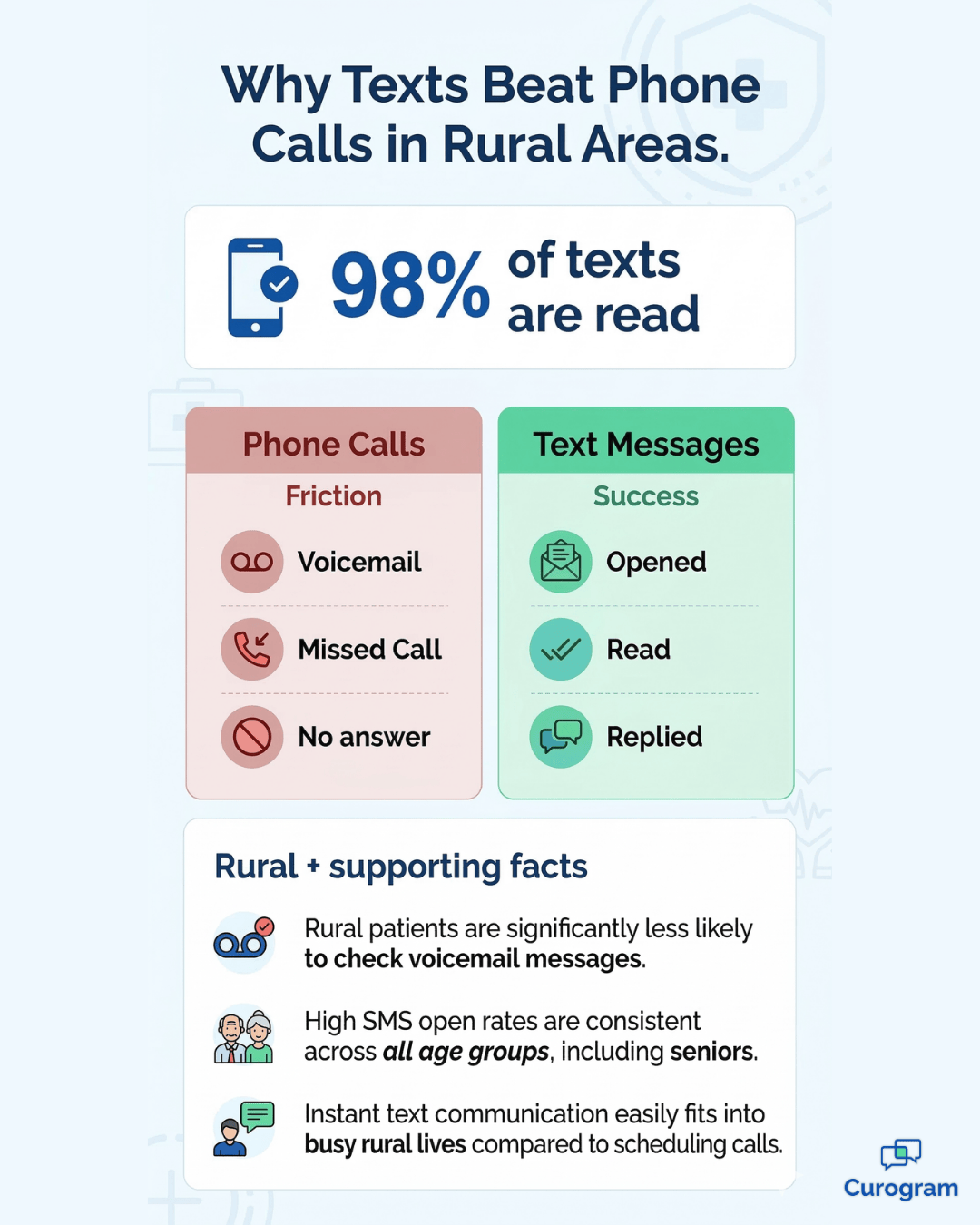
Texts carry a 98% open rate. Phone calls in rural areas? Under 50% answer rate. The math alone tells you something important about how your patients are getting — or missing — your messages right now.
Whether it's a sick day, an ice storm, or an unexpected schedule change, the front desk mass rescheduling tool inside Curogram gives you the speed to reach everyone before the damage is done.
No scrambling. No three-hour phone marathon.
Below, we break down exactly why the traditional process fails, how Curogram fixes it, and what it looks like when office manager crisis communication in rural healthcare finally works the way it should.
Azalea Health does its job well — tracking every appointment, every provider, every time slot. But when the only provider at a Critical Access Hospital texts at 5:45 AM with a fever, the EHR doesn't have a tool to notify every scheduled patient all at once.
So the office manager opens the schedule, counts 32 patients, and starts dialing.
This isn't a technology gap — it's a workflow gap. Scheduling software handles appointments. It was never built to handle the rural clinic staff emergency notification system that kicks in when those appointments fall apart.
In a multi-provider urban practice, a single provider absence is inconvenient. In a single-provider rural clinic, it shuts everything down. There's no one to cover, no backup schedule to pull from, and no buffer between the office manager and 32 confused, frustrated patients.
Each phone call takes two to three minutes if someone answers — longer if the manager needs to explain options and reschedule on the spot. Half the calls go to voicemail.
And rural patients don't always check voicemail before heading out the door.
By 7:30 AM, the manager has reached maybe 20 patients. The other 12 are driving, already en route, or about to walk into a dark parking lot at 8:00 AM.
Meanwhile, the clinic's main line is tied up, so patients calling in for other reasons can't get through either.
The office manager isn't just burning time — they're burning goodwill. Every patient who shows up to a dark clinic is a patient who questions whether your practice is organized and reliable. In rural communities, word travels fast, and that reputation takes years to rebuild.
And this happens more than once a year. Provider sick days, weather closures, unexpected schedule changes — each one triggers the same manual scramble.
Every single time, the process is identical, exhausting, and completely avoidable.
The phone-call scramble doesn't end when the last patient is notified. The office manager now faces two weeks of rescheduling — squeezing 32 patients into a calendar already booked out three weeks.
Patients who showed up to a closed clinic call back frustrated. Chronic care patients miss critical follow-ups.
The manager, who handled the crisis alone while the rest of the staff wasn't yet on shift, starts the week exhausted and behind on everything else. It's not just a bad morning — it's a ripple effect that lasts for days.
There's also a hidden cost to staff morale.
When office managers spend three hours on crisis calls before the workday even begins, it drains energy that should go toward patient care, billing follow-ups, and the dozen other tasks that keep the clinic running.
They've tried phone trees, but those rely on patients answering and passing the message along.
They've tried email, but their elderly patient population doesn't check email at 6 AM. What they need is a tool that reaches everyone instantly, on the device they actually use.
|
Text message open rate — all demographics: 98% Patients read texts. That's why a mass text reaches everyone the phone can't. |
That 98% open rate is exactly the reason a mass alert reaches your patients when a phone call can't — and it's what makes Curogram the right tool for the job.
Curogram's mass messaging turns the office manager from a one-person call center into an emergency communication coordinator.
Instead of dialing 32 patients one by one, she opens Curogram, selects today's scheduled patients from the Azalea Health integration, picks the pre-built "Provider Absence" template, and hits send. Ninety seconds. Every patient notified. A rescheduling link included.
The scramble is over before the rest of the staff even arrives. That's not a small efficiency win — it's a complete change in how the hardest mornings of the year feel for the people running rural clinics.
What makes this work isn't just speed. It's the combination of a pre-built message, a live patient list pulled from Azalea Health, and a 2-way inbox that catches every reply.
Each piece removes a step that previously required a phone call, a decision, or a moment of composing under pressure.

Curogram's template library lets office managers create and save messages for the most common disruptions before a crisis ever happens. When the 5:45 AM text arrives, there's nothing to write. The message is already drafted, reviewed, and ready to go.
This matters more than it sounds. When you're half-awake, staring at 32 patient names, the last thing you want is a blank text field waiting for you to say something clear and professional. Templates remove that friction entirely.
Here are the five template types that rural clinics rely on most:
Each template is customizable before you save it — so your clinic's voice stays consistent even under pressure. And because they live inside Curogram, they're accessible from any device, anywhere.
You can also build templates for scenarios specific to your clinic — a flooding route that affects certain patients, a specialist who only comes in on Thursdays, or a recurring equipment maintenance window.
The library works for whatever your practice needs it to handle.
| Template Name | When to Use It | Typical Send Time |
|---|---|---|
| Provider Absence | One or more providers call out sick | 5:45–7:00 AM |
| Weather Closure | Ice, storm, or unsafe road conditions | 5:00–6:30 AM |
| Schedule Change | Last-minute appointment shifts or room changes | Day before or morning of |
| Holiday Hours | Reduced or modified clinic hours | 2–3 days before |
| Public Health Advisory | Infection alerts, mask requirements, safety notices | As needed |
Curogram pulls today's schedule directly from Azalea Health, so the office manager doesn't have to manually select patients or cross-reference a list.
The system already knows who's scheduled, which provider they're seeing, and what time their appointment is.
That integration removes one of the most error-prone steps in the old process — manually identifying which patients to call. When you're working fast and tired at 6 AM, it's easy to skip a name or dial the wrong number.
Curogram eliminates that risk by pulling the list automatically.
Patient replies flow back through Curogram's 2-way texting inbox, so follow-up questions are handled in the same thread.
There's no switching between phone and computer — it all lives in one place. That seamless connection is what makes it feel less like a workaround and more like a real emergency communication system.
Because Curogram integrates with Azalea Health rather than replacing it, nothing changes about how your practice manages appointments, notes, or billing. You keep using the EHR you already know. Curogram simply adds the communication layer that Azalea Health doesn't have built in.
Office managers at RHCs and FQHCs wear more hats than almost anyone else in healthcare. They're the scheduler, the billing specialist, the patient liaison, and the crisis manager — often all before 9 AM.
Curogram's mass messaging removes the most time-consuming task from their plate on disrupted days.
Instead of being chained to the phone for three hours, the office manager can focus on rescheduling, supporting the remaining staff, and keeping the clinic running.
That time savings isn't theoretical. Three hours of crisis phone calls is three hours not spent on prior authorizations, insurance follow-ups, patient check-in prep, or the staff coordination that falls apart on a disrupted day. Getting that time back changes what's possible before noon.
It also changes how office managers feel about their role. The scramble is one of the most demoralizing experiences in clinic operations — not because the work is hard, but because it feels endless and avoidable. Curogram makes it avoidable.

The transformation Curogram delivers isn't just about speed — it's about what you get to do with the time you get back.
Office managers using mass messaging replace two to three hours of individual phone calls with a single 90-second text, reclaiming their entire morning on the most chaotic days of the year.
Think about what three hours actually means on a disrupted day. It's the difference between a manager who starts the week behind on everything and one who spends the morning rescheduling, briefing staff, and putting the clinic back in order before the phones even get busy.
The move is from
"The 6 AM Scramble" to "The 90-Second All-Clear." During a provider absence, the manager's role shifts from frantic individual outreach to calm, systematic follow-up.
The mass text handles notification. The manager handles exceptions.
The emotional toll of the scramble disappears. What used to ruin the whole week now takes 90 seconds — and the rest of the morning belongs to the office manager again.
There's also a secondary benefit that doesn't show up in time savings: fewer patients arrive frustrated.
When patients get a text before they leave home, they have time to adjust their plans.
When they show up to a dark building, they're upset — and that anger gets directed at the front desk for the rest of the day.
Curogram's mass text doesn't just save time. It protects the patient relationship at its most vulnerable moment — the moment when something goes wrong and patients decide whether your clinic is one they can count on.
The numbers tell the story clearly. With the old process, notifying 32 patients takes two to three hours, ties up the main phone line, and still leaves several patients driving to a closed clinic.
With Curogram, the same task takes 90 seconds — and every patient gets the message before they leave home.
The contrast isn't subtle. Time, goodwill, staff energy, and patient trust are all on the line during a provider absence. Curogram protects all of them before the workday even starts.
Lisa manages a single-provider FQHC in rural Appalachia and uses Azalea Health to run the schedule. She used to dread winter mornings.
One ice storm meant three hours on the phone, 15 voicemails left unreturned, and four patients who drove 40 minutes to a closed clinic.
After implementing Curogram's mass messaging, her last weather closure took 90 seconds to communicate. She sent the text at 5:50 AM, included a rescheduling link, and had 26 of 31 patients rebooked by 8:00 AM.
Zero patients showed up to a closed building.
She spent her morning helping the billing team instead of apologizing to frustrated patients on the phone. That's the kind of shift that changes how you feel about your job.
Lisa's story isn't unusual. It's what happens when office manager crisis communication in rural healthcare finally has the right tool behind it. The crisis doesn't go away — but the chaos does.
The 6 AM provider text doesn't have to ruin your entire week. With Curogram connected to Azalea Health, a bulk patient cancellation text goes out to every patient in under 90 seconds — before anyone drives to a closed parking lot.
Azalea Health manages your scheduling and clinical records. Curogram manages the instant notification when that schedule changes. Together, they ensure no office manager faces a provider absence alone with only a phone and a prayer.
Stop letting a single early-morning call define how your whole day goes. Build your emergency notification templates today — "Provider Absence," "Weather Closure," and "Schedule Change" — so the next disruption is a 90-second event, not a 3-hour ordeal.
And when a patient replies with a question?
It lands right in Curogram's 2-way texting inbox, in the same thread as the original message. No phone tag. No switching between systems. Just clean, fast, HIPAA-compliant communication that keeps your clinic — and your composure — intact.
Schedule a demo today and see how Curogram helps rural clinics like yours handle the unexpected without losing a full day to the phone.
Curogram is cloud-based and works from any device with a web browser — including your smartphone. If you get your provider's sick-day text at 5:45 AM while you're still at home, you can log into Curogram on your phone, select the pre-built template, and send the mass notification from your kitchen table. There's no need to drive to the office first.
Some patients will reply with questions, and those replies come through Curogram's 2-way texting inbox as individual conversations. You handle them one at a time, at your own pace, instead of fielding a wave of inbound phone calls. Most patients will simply click the rescheduling link in the mass text and self-reschedule, which cuts your follow-up workload significantly.
Yes. Curogram's patient segmentation lets you filter by provider, appointment date, appointment type, or any combination. If Dr. Smith is out but Dr. Jones is still seeing patients, you send the cancellation text only to Dr. Smith's patients. Dr. Jones's patients receive no alert, so there's no unnecessary confusion on a day that's already complicated enough.
Yes. Curogram is built specifically for healthcare, so HIPAA compliance is baked into the platform — not bolted on as an afterthought. Mass texts sent through Curogram are designed to carry general appointment information without transmitting protected health information over unsecured channels.
Most office managers have their first three emergency templates built within 10 minutes of getting access. The setup process is straightforward — Curogram connects to Azalea Health, you create your templates, and the system is ready to use the next time a disruption hits.
💡 Mass text messaging for Azalea Health rural clinic patient alerts lets rural practices reach every scheduled patient in seconds when a provider...

💡 Azalea Health 2-way HIPAA compliant texting for rural clinics bridges the gap between EHR-based care and patients who cannot reliably access a...
💡 HIPAA text messaging transforms the patient experience at Azalea Health rural clinics by meeting patients on the device they already carry —...