
 Jo Galvez
UDS measures count completed care. A patient seen earlier in the year stays in the measure's denominator, so a missed screening or blood pressure recheck counts against the center.
Sliding fees and payer mix make one dollar figure per visit wrong for most centers.
Outreach that brings overdue patients back recovers visits and measure points. It can't fix care the center can't staff.
A missed visit at a community health center costs three things. It's a visit the center can't bill, a quality measure that reports short, and a weaker position in the reporting that shapes its funding.
Most centers count the first, feel the third, and underestimate the second, even though the second is the one that follows a center into its next grant cycle.
That's why the community health center no-show cost picture runs wider than revenue: quality measures and funding sit in the same chain. The finance report shows an empty slot.
The UDS report, months later, shows a patient who never got screened. A board member reading both rarely sees that they're the same event.
A common belief says no-shows are mainly a revenue leak, so the fix is overbooking. At a health center, overbooking fills the chair with someone else and leaves the overdue patient overdue. The measure still reports short, because the person it counts never came in.
This page is for the COO building a case for a board, a funder or a site visit. You won't find a per-visit dollar calculator here, because payer mix and the sliding fee scale make any single number wrong for most centers.
You'll find where each cost lands, how a missed visit turns into a short measure, and what outreach can and can't fix.
Curogram, Azalea Health's patient engagement partner, works on that chain for health centers on Azalea Health. Most of that work is bringing overdue patients back before the reporting year closes.
The Three Places a Missed Visit Shows Up
Each cost hits a different report on a different clock, and a different person reads it.
Revenue And The Measure
Revenue first. The visit didn't happen, so nothing was billed, and the provider's time in that slot is already paid. CHC revenue missed visits pile up in a monthly report nobody reads twice, because each one looks small.
Then the measure. Health centers report clinical quality measures through HRSA's Uniform Data System (UDS), and you can see how UDS measures are reported on HRSA's own training pages.
A measure only counts care that happened. An open slot on the day of a planned Pap test or A1c draw becomes a gap in that measure at year-end.
Position, And Who Reads Each One
Third, position. UDS results feed how boards, funders and HRSA read a center's performance, alongside grant reports and site visit findings.
A short measure set tells a story before anyone asks why, and the reader rarely sees the disconnected phone numbers behind it.
Revenue lands this month, the measure lands at year-end, and position lands when someone outside the building reads your numbers. Your finance lead watches the first, your quality lead the second, and the CEO the third. Few centers put all three on one page.
A Visit the Center Cannot Bill or Defer
Sliding Fee Scale And Payer Mix
Health centers must serve everyone regardless of ability to pay, and they charge uninsured patients on a sliding fee scale tied to income. RHIhub's guide explains how federally qualified health centers are funded, from Section 330 grants to Medicaid.
So a sliding fee scale no-show behaves differently from a missed commercial visit. The center still staffed the slot, and its grant still expects that patient to be served. So the cost lands in staff hours spent and in care the grant paid for but didn't get.
Why There's No Dollar Figure Here
The visit a center lost may have been the one Medicaid would have paid at a rate that keeps the lights on. Or it may have been a $20 sliding fee visit.
Any single FQHC missed appointment cost hides that spread. A board that sees one number tends to act on it, so we'd rather give the parts.
If you want per-encounter math, we ran the per-encounter arithmetic for a Rural Health Clinic separately. One payment rate makes it possible there.
Why The Visit Rarely Reschedules Itself
A no-show here usually has a reason that's still there the next morning. A mother with a 7:30 shift at the plant can't make a 9:00 well-child visit, and her ride works Tuesdays only.
Nobody calls her back that week, because the desk is running a full room. By the time someone does, her number has changed. A text she can answer, offering Thursday at 4:30, keeps the visit alive. She replies from the break room in under a minute.
A Measure That Reports Short
One Patient, Step By Step
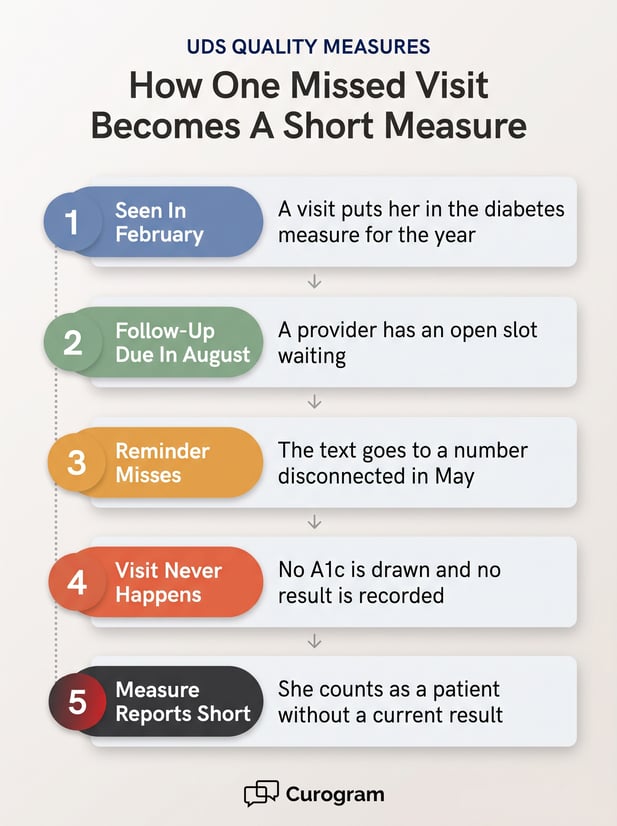
Take a patient with diabetes, seen in February, who is due for a follow-up in August. Care was available, since a provider had an open slot for that follow-up. The lab could draw her A1c the same morning, and the protocol said to.
Then the reminder went to a number disconnected in May. The visit didn't happen, and no A1c was drawn. None of those steps involved a clinical decision; each one was about reach. Her phone number was the weak link, and nobody knew it had changed.
Why She Still Counts Against You
Her February visit already put her in the measure's denominator, as the 2025 UDS Manual sets out. So she reports as a patient without a current result, and the measure drops. Ten patients like her can move a small center's rate by several points.
Blood pressure works the same way. The hypertension measure uses the last reading of the year. If her March reading was high and the June recheck never happened, March is the number that reports.
What Patient-Level Reporting Changes
Health centers now also submit de-identified patient-level data, called UDS+, beside their standard UDS report. Gaps now show record by record, so the overdue patient behind each gap is easier to find and contact.
Screening and chronic care measures need a visit, a lab, or both. HRSA's January 2026 program update put national health center colorectal cancer screening at 43%. We cover running a recall campaign against a UDS measure step by step.
Standing at Reporting Time
What A Short Measure Set Signals
From the outside, a short measure set reads like a care problem. We think it's more often an access problem. The center had the provider, the lab and the protocol, and the patient never reached the room.
That difference matters when a funder reads your health center grant position, quality measures and all. A center that can show its overdue list shrinking can explain its numbers. One that can't is left defending care it never got the chance to give.
The Cheapest Fix On The List
Adding a provider costs a full salary and months of hiring. A text to an overdue patient costs minutes of staff time, and the provider is already on the schedule with open slots.
So show the board the overdue count for one measure in January, the recall you ran, and the count in March. A trend line of patients reached answers a short measure better than a promise to try harder. It also gives the quality lead something to report each month.

What Outreach Recovers, and What It Does Not
Curogram Highlight: Two-Way Recall Messaging
Two-Way Recall Messaging in Curogram sends a recall text to patients who are past due, and the patient answers in the same thread to book.
In one multi-location practice, 35% of patients who got an SMS recall booked within a month. In all, 1,240 patients were seen from recall messages alone, based on Curogram client data from clinical settings.
That practice wasn't a health center, so treat the figure as recovery evidence. On Azalea Health, confirmed or canceled replies write back to the schedule. Automated appointment reminders cover visits already booked.
Where each cost lands and what recall changes
|
Cost |
Where it shows up |
What recall changes |
What it does not fix |
|
Unbilled visit |
Monthly revenue |
Overdue patients rebook |
Patients with no working number |
|
Short measure |
UDS submission |
Completed visits enter the numerator |
Care the center cannot staff |
|
Reporting position |
Funder and board review |
A defensible access story |
A panel the center never had |
Where to Start With Your Overdue Panel
Pick one measure, one patient segment, and one SMS campaign. Colorectal screening or blood pressure control is a good first choice, because the overdue list is easy to pull.
Count the list on day one and again on day 30, and count booked visits, not texts sent. Our guide to panel outreach for FQHCs on Azalea Health covers the wider plan, and the Azalea Health integration page covers setup.
Book a demo and see what one recall campaign returns against your overdue panel.
Frequently Asked Questions