
7 min read

Reactivation That Books | athenahealth Networks

Reactivation That Books | athenahealth Networks
 💡 Automating patient reactivation outreach in athenahealth networks starts with one change. You grade the program on appointments booked, not attempts made. Letters and robocalls produce strong completion reports and weak response, so the schedule never changes.

Curogram sends automated recall texts built from visit and care gap data. Each one comes from the location's own local number and is paced to open slots. Staff step in only when a patient replies ready to book.

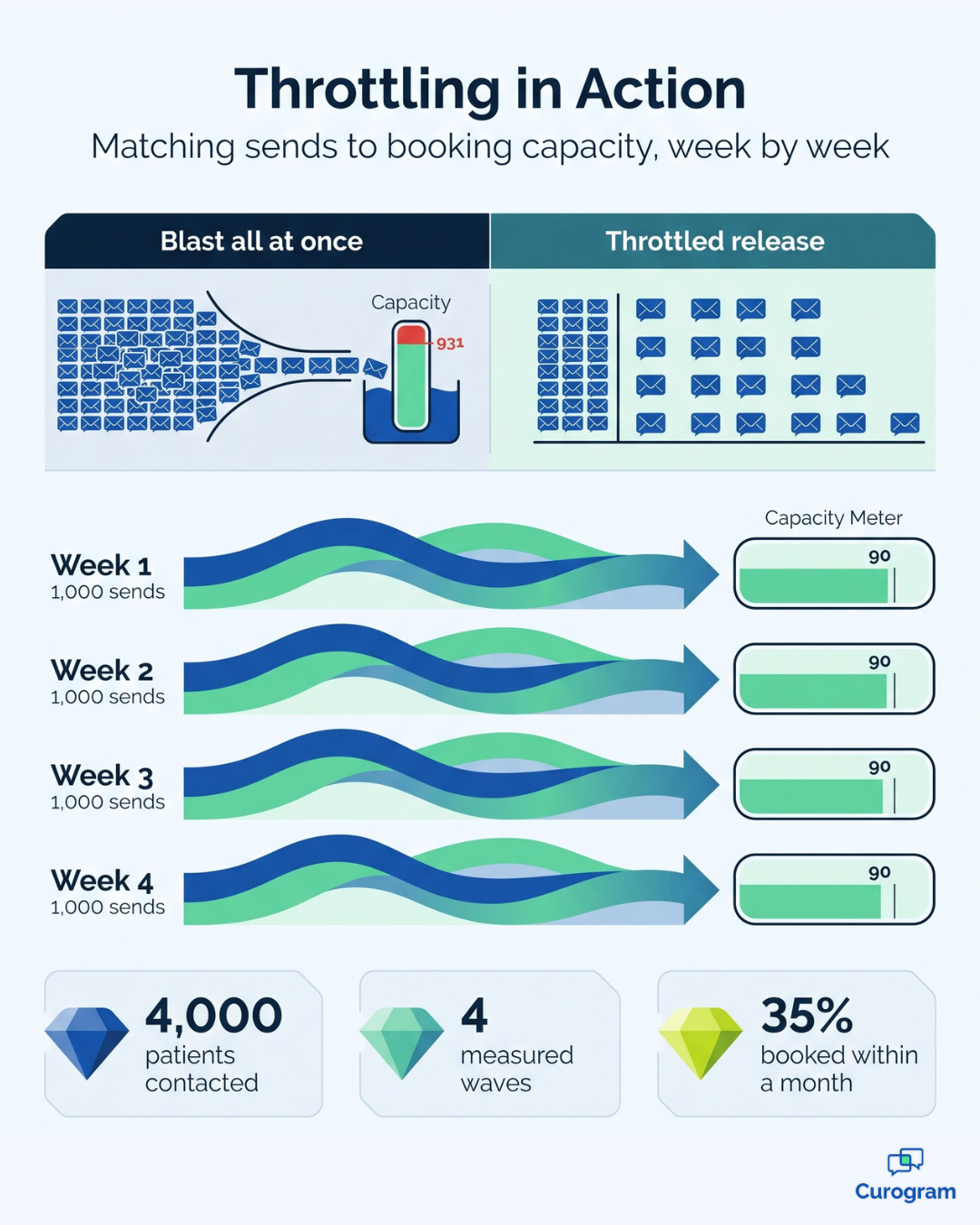
That ends what we call "The Compliance Theater." At one multi-location practice, 35% of patients who got an SMS recall booked within a month.

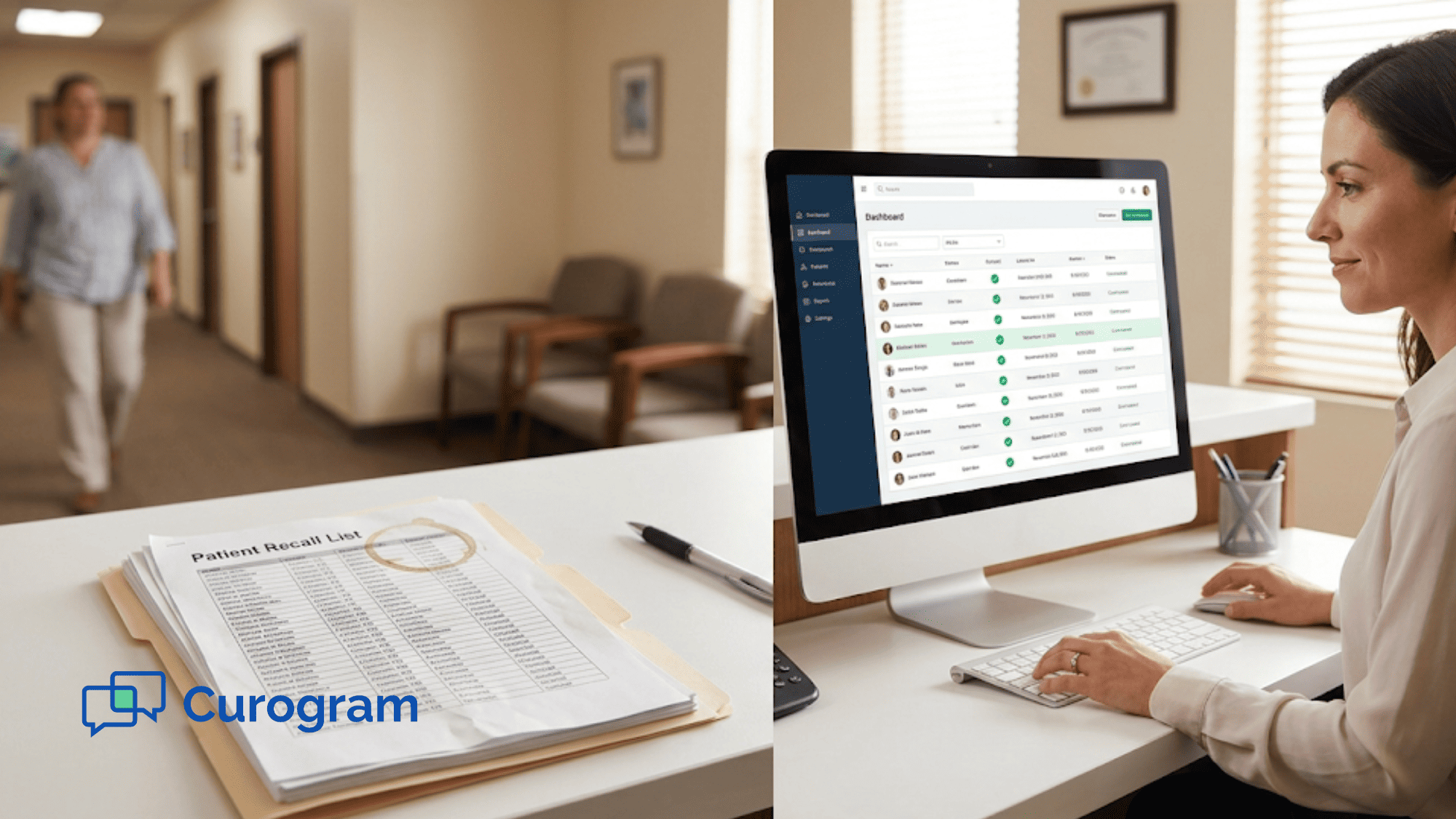
Last quarter's recall report looks flawless. Four thousand letters mailed, every overdue patient contacted, outreach completion logged at 100%.

Now open next week's schedule.

The same gaps are sitting there, and the same lapsed patients are still lapsed. About two dozen people called back, and half of them only wanted clarification on what the letter actually meant. An entire quarter of coordinated effort turned into paper, postage, and a checkbox.

Nobody on your team did anything wrong, which is the frustrating part. They pulled the list, ran the merge, hit every internal deadline, and satisfied every requirement the program set. The outreach performed exactly as it was designed to perform.

The design is the problem.

Recall and care gap programs across most athenahealth networks get graded on effort instead of outcome: letters mailed, calls attempted, patients technically reached.

Those numbers are easy to pull and easy to defend in a quarterly review, but not one of them tells you whether a single exam room got filled.

Meanwhile, the patients you are trying to recover are holding a phone.

They answer texts from their pharmacy, their dentist, and their child's school within minutes, and they have not opened mail from a medical office in years. You keep sending messages down a hallway they stopped walking through a decade ago.

Here is what makes this costlier than a wasted mailing.

Lapsed patients are the cheapest appointments your network will ever book, because they already exist in your system and already trust your providers. No marketing spend, no referral, and no new chart to build.

Yet the highest-return outreach you own is allowed to fail quietly, quarter after quarter, while the report insists everything is on track.

The fix is not more effort. It is a different channel paired with a different scoreboard.

The Outreach Report Everyone Passes and Nobody Feels

Compliance theater starts when a program measures what it can control instead of what it needs. Mailing 4,000 letters is completely within your control, while persuading 4,000 people to call back is not.

Over time, the metric drifts toward whichever number the team can promise in advance.

The established pattern behind letters and robocalls is low response, and it has held for decades. Direct mail to an existing patient list usually pulls a low single-digit reply rate. Automated voice calls perform worse, because most recipients screen them or disconnect within the first few seconds.

Put real numbers against a single quarter of that work.

Line item (illustrative example) Cost per quarter
Printing and postage, 4,000 letters at $0.85 each $3,400
Staff time to pull, verify, and process lists (40 hours at $25) $1,000
Returned mail, patient questions, manual follow-up calls $600
Total program spend $5,000
Appointments actually booked (2% response, most needing a callback) About 40
Cost per booked appointment About $125

Those figures are a sample scenario, not client data. Swap in your own postage rate and hourly wage and the shape holds. You spend real money to buy a handful of visits, then repeat the exercise three months later.

The cost that never shows up on that table is considerably larger. Nearly 4,000 patients remained overdue, which means their diabetes checks, mammograms, and wellness visits all slipped another quarter. Your providers kept working half-empty schedules while a complete panel sat untouched in the database.

There is a downstream cost as well. Open care gaps drag on quality scores, value-based contracts, and the risk adjustment data your network depends on.

A patient who disappears for two years is not simply a missed visit. They become a documentation gap that requires considerably more effort to close later.

So the program passes its audit and fails its purpose. Reactivation is the highest-return outreach any network can run, and it stays locked at the response rate the mail channel established for it years ago.

A Recall Engine Built Around the Channel Patients Actually Answer

Curogram treats reactivation as a conversion problem, not a mailing problem.

The goal is not to touch every name once. The goal is to work the list until it books, then run the cycle again next month.

Infographic showing recall texts released in four weekly waves matched to open appointment slots

Segments built from data you already keep

Campaigns pull straight from visit history and care gap data. An overdue mammogram, a lapsed diabetic follow-up, and a patient unseen for 18 months each get their own message path.

Your care gap outreach workflow stops being one giant mail merge and turns into a set of targeted, repeatable conversations.

Messages from a number patients recognize

Every text comes from that location's own local number, in the patient's preferred language, using templates your network approves centrally. The patient sees their neighborhood clinic, not an unknown 800 number.

That one detail moves reply rates more than any wording change. Governance stays at the network level while the experience stays local.

Sending paced to what the schedule can absorb

Booking 600 people into a week with 90 open slots just trades one problem for another. Campaign throttling is tied to booking capacity, so messages release in waves that match what each site actually has open. Replies then arrive at a volume the front desk can handle.

Reporting that shows bookings, not busywork

Per-location recall reporting shows sends, replies, and confirmed appointments by campaign and by gap type.

When a regional director asks which sites are recovering their panels, the answer is on one screen instead of spread across seven spreadsheets. You can compare locations directly and spot which gap types convert fastest.

Reach every patient in seconds. Use mass messaging for urgent closures, health alerts, or clinic news with a 98% open rate with Curogram.

Interested replies land in a shared inbox with the patient's context attached, and confirmed appointments flow into the athenahealth schedule. Reactivation campaign operations get lighter, not heavier, because the repetitive part runs on its own.

What Changes When Your Team Only Touches the Yeses

The daily job shifts completely. Staff stop producing outreach and start closing it.

Take that same 4,000-patient list and send it as recall texts instead of letters. At the 35% reconversion Curogram measured with a multi-location practice, that works out to roughly 1,400 booked appointments from one cycle.

Nobody stuffs an envelope. The front desk answers patients who already said yes.

Three things change immediately:

  1. Effort moves to the productive end of the funnel. No printing, no merges, no cold callbacks, just warm replies from patients ready to schedule.
  2. The whole panel gets worked every cycle. Automation never runs out of time on a chaotic Thursday, so no location quietly skips a month and no segment gets dropped halfway through.
  3. The scoreboard finally matches the goal. Your outreach list conversion rate becomes the headline number, and leadership can tie it straight to recovered revenue.

The revenue math is simple enough to do on a napkin. If an average visit is worth $150, then 1,400 recovered appointments come to about $210,000 in one cycle under that sample scenario.

Even at a fraction of that response, the comparison against a $5,000 mailing that booked 40 visits is not close.

One quieter benefit deserves a mention. Texting cuts inbound call volume sharply, and Curogram clients see calls drop by about 50% along with a 30% or better gain in front desk productivity.

The same team that could barely finish one mailing a quarter can now run recall, reminders, and follow-up at the same time.

Automating patient reactivation outreach in athenahealth networks does not add a project to anyone's plate. It removes the part of the job that was never converting, and hands back the hours that work used up.

Ask What Last Quarter's Outreach Actually Booked

Before you evaluate any platform, run one test against your current program. Pull last quarter's recall numbers and ignore every figure except one: how many appointments were booked.

Not mailed. Not attempted. Booked.

If your reporting cannot answer that within a few minutes, you have identified the underlying issue.

A program nobody can measure in bookings is a program nobody can improve, and it will keep consuming budget indefinitely. If the answer comes back as a few dozen visits from several thousand attempts, your business case is already written for you.

Keep in mind what each system is built to do. athenaOne holds your record of who is overdue, and it handles that responsibility well, tracking every gap, every lapsed panel, and every patient who belongs on the schedule.

What it does not give the patient is a one-reply path back through the channel they actually answer.

That is the gap Curogram closes. Your record of the problem stays exactly where it lives today. The conversation that solves it happens by text, from each location's own number, at a pace your schedule can absorb, with every booking tied back to the campaign that produced it.

Those patients are not gone. They are reachable this afternoon, holding the device they answer within minutes, waiting on a message that never arrives because the program is still measured in postage.

Schedule a consultation with Curogram and we will map this to your network. We will look at your real gap segments, your per-site booking capacity, and the throttle rates that fit your front desk. 


Frequently Asked Questions

How much setup does this take?

Campaigns are configured once with your team. You define segments, approve templates, set cadence, and choose throttle rates per location, and from there they run on schedule. Ongoing staff involvement is booking the patients who reply, which is work your front desk already does every day.

Can campaigns differ by location or by gap type?

Yes. Sender identity, language mix, throttle rate, and active segments are all tunable per location under network-level governance. Each gap type follows its own message path, so a mammogram reminder never reads like a diabetes follow-up. Corporate keeps control of approved language while sites keep control of pacing.

How do we know it is working?

Dashboards report sends, response rate, and booked appointments attributed to each campaign, broken out by location and by month. You can compare sites directly, see which gap types convert best, and connect recovered revenue to specific campaigns. The reporting answers the booking question instead of the attempt question.

What happens when a patient replies with a question instead of a yes?

The reply lands in a shared inbox with the patient's history attached, and a staff member answers it like any other message. Most questions are simple: office hours, provider availability, whether their insurance changed. Automation opens the conversation and your team closes it.

Our patient data is not perfectly clean. Will this send the wrong messages?

Segments are built from the visit and gap data you already work from, so accuracy matches your existing records. A few safeguards help. Start with one narrow, well-defined segment, review the send list before the first cycle, and use throttling to release a small wave first. Most networks clean up their data during the first two campaigns, because bad numbers show up fast.