
 Jo Galvez

The patient texting platform challenges that sink a purchase number about six, and all six are findable before you pay for anything.
None needs a year of ownership to spot. What they need is a demo where you ask for a live action instead of a slide, and a pilot narrow enough to answer clearly inside a month. Patient texting communication platforms all demo well, which is the problem.
We have written elsewhere about repairing a rollout that has already stalled. Run this screen first instead, while the vendor still wants your signature.
Challenges Rooted In The EHR Connection
Integration that reads but never writes
Read-only integration pulls your schedule into the texting tool and sends nothing back. A patient confirms, the tool logs it, and the chart still shows the visit unconfirmed.
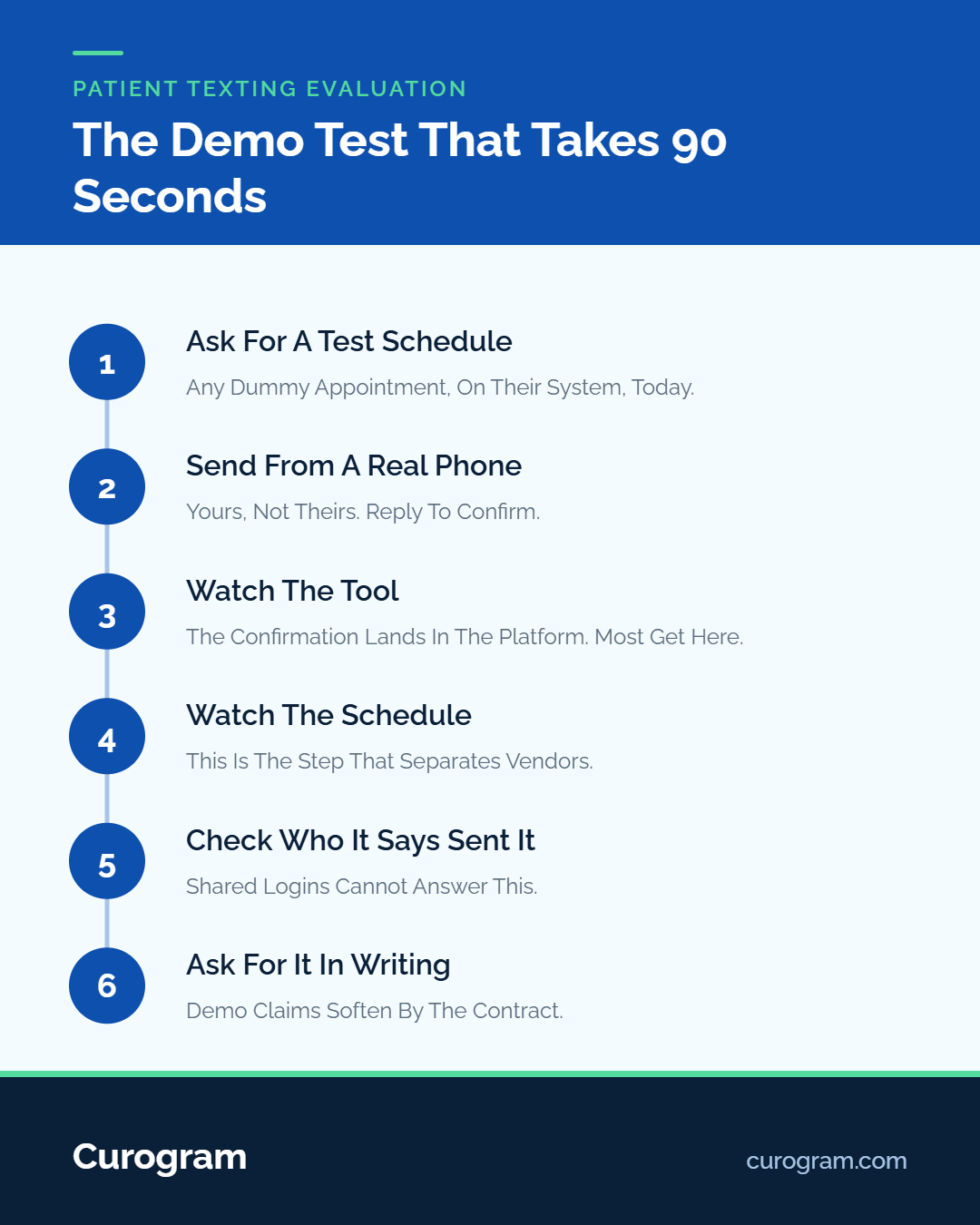
Staff find out by calling people who already replied. Ask for one thing in the demo: a live confirmation, sent from a real phone, posting to a test schedule while you watch. A vendor whose sync writes back does this in about 90 seconds. A recorded clip or a roadmap date is an answer too.
Partial write-back is the version that fools people. Confirmations post, but a cancellation or a reschedule does not, so the tool looks fine until a patient moves an appointment. Ask about all three actions by name, not just confirmation. Then ask what the schedule shows when two of them arrive a minute apart.
Sync scope that stops at demographics
Sync scope is the list of record types that move between systems. Plenty of platforms move patient details and stop there. That looks like integration until the first reschedule.
What goes missing is appointment status and the message record itself. Nobody reading the chart can tell the patient was told anything. Ask which objects sync, in which direction, and get it in writing.
HL7 and FHIR are the standards that move this data between systems. A platform that supports them tends to reach more EHRs, but support alone says nothing about scope.
Get the list by object. Patient record, appointment, appointment status, the message thread itself, opt-out flags, uploaded documents. Ask which of those six move, in which direction, and whether any of them are one-way only on your particular EHR.
|
Challenge |
What it costs after purchase |
Evaluation test |
|---|---|---|
|
No write-back |
Staff call patients who already confirmed |
Live confirmation into a test schedule |
|
Thin sync scope |
Double entry at the desk |
Ask which objects sync, in writing |
|
Weak role controls |
No answer to who sent what |
Request an audit log export |
|
Poor opt-out handling |
Contact after a stop request |
Ask where opt-outs are stored |
|
Unowned reply queue |
Patients call back |
Ask how a thread gets an owner |
|
No per-site reporting |
One location drags the average |
Ask for a per-location report |
Challenges Rooted In Accountability
Role controls that stop at a shared login
One shared login is still common, and it is cheap right up until somebody asks who sent a message. There is no answer. Every action carries the same name.
Offboarding turns into a scramble too. A leaver holds the same login as everyone else, so you cannot cut one without cutting all. HHS sets out what a vendor deal has to cover in its sample business associate agreement provisions, published in 2013 as model language rather than a safe harbour.
Ask for an audit log export covering a real week. If the vendor cannot produce one, the control is not there.
Check what a row in that export actually contains. A usable one names the sender, the patient, the timestamp and the message. A log that records only that a message was sent at 10:42 answers nobody's question.
Opt-out handling nobody can show you
An opt-out is a patient asking you to stop. Under TCPA, you have to honour it, and the FCC's TRACED Act report and order, adopted 29 December 2020, requires callers to give recipients of exempted calls a way to opt out.
Read that order before quoting it to anyone. Its healthcare limits of one per day and three per week apply to prerecorded voice calls to residential lines, not to texts. What matters for SMS communication platforms is the opt-out duty itself. Ask where a stop request is stored, whether it applies across every site and message type, and what happens when that patient is re-imported from the EHR next month.
That last one catches platforms out. An opt-out held only in the messaging tool gets overwritten the next time your patient list refreshes from the chart, and the patient who asked you to stop hears from you again.
 Challenges Rooted In Staffing
A reply queue with no owner
Two-way texting creates inbound volume. That is the point of it. It is also the part most buyers skip, because a demo shows one message landing and one person free to answer.
Ask how a thread gets an owner. The answers that work are assignment rules by destination, visible ownership inside the thread, and reassignment when someone is out. A shared inbox with none of those is a pile, and patients whose messages sit in it phone you instead. This is where healthcare messaging stops being a software question and starts being a staffing one.
Ask what the platform does when nobody picks a thread up. An unanswered-thread alert after a set number of hours is the feature that catches the message everyone assumed a colleague had handled. Ask who that alert goes to, as well. One that fires into the same unwatched queue changes nothing.
Coverage the vendor assumes you already have
Vendors demo the happy path: one user, one screen, one message. Your front desk is not staffed like that at 12:30, during a call-out, or at a satellite with one person on the desk.
So ask what happens at lunch. Can a float be given time-boxed access to one site for one week? Can an open thread be handed to somebody else mid-conversation? Does one deactivation remove access everywhere while the history stays in the log?
Ask about after hours in the same breath. A message landing at 7pm needs an automatic acknowledgement with a response window, or your team opens Monday to a queue of patients who assumed nothing arrived and called instead.
None of that shows up in a demo unless you ask for it, because the demo has one user and no lunch break.
Challenges That Only Appear At Scale
Per-location blindness
Reporting that rolls every site into one number is the default, and it hides what a multi-site group most needs to see. One office at 40% confirmation and another at 90% average out to something that reads as fine. Most clinic communication challenges look smaller from head office than they do at the desk.
Ask to see a per-location report in the demo, with confirmation rate and response time broken out by site and by week. Ask who can run it, too. A report only the vendor can produce is a support ticket, not a management tool.
Ask whether it can be scheduled. A report somebody has to remember to pull gets pulled for two months and then stops, which is how a site drifts for a quarter before anyone notices.
Message volume and deliverability
Texting patients from a 10-digit business number means signing your campaign up with The Campaign Registry first. Carriers throttle, filter or drop traffic that is not registered.
That failure is silent. A reminder that never lands looks just like one a patient ignored, so it can run for months unnoticed. Ask who files the paperwork, how many texts your number can send per minute, and who steps in when a carrier starts filtering you.
Throughput matters more than it sounds for a group sending a morning reminder batch. A number rated for a low send rate will still deliver, just slowly, and a reminder that arrives at 2pm for a 9am visit has missed its job.
Ask to see delivery reporting as well. Sent and delivered are different states, and a platform that only reports the first cannot tell you this is happening.
Turning The List Into An Evaluation
A scorecard you can fill in during the demo
Six rows, pass or fail, no adjectives:
- Write-back demonstrated live, into a test schedule
- Sync scope confirmed in writing, by record type and direction
- Audit log exported for a real week
- Opt-out storage named, and tested against an EHR re-import
- Thread ownership shown inside the inbox
- Per-location report produced during the call
Score it while the vendor is talking, not afterwards. Claims soften between a demo and a statement of work, and a row you marked live is the one you can hold them to. Any row that comes back as a roadmap date is a fail today.
Weight row one above the rest. A platform that fails write-back but passes the other five will still leave your desk retyping, which is the cost you were buying the tool to remove.
What a 30-day pilot has to prove
One workflow, one site, one number, written down before you start. Confirmations at your busiest office is the usual pick, because the answer is clear inside a single reminder cycle.
Name the number you need to see. Something like: 60% of reminders answered by reply, with every reply posting to the schedule without staff retyping it. A pilot with no threshold is a demo that lasted a month.
Give it to the site that will be hardest on it. A pilot at your best-staffed office tells you what the tool does under ideal conditions, which is not the condition you need to plan for.
Decide in advance what a miss means too. A near miss with a clear cause is worth a second month. A miss nobody can explain is the answer.

Where Curogram Lands On These Six
Patient engagement tools and clinical communication tools often get sold together, so be clear which you are buying. Curogram texts from the office number you already use, and connects with 150+ EMR and practice management systems at depths that vary. Ask us the tier question too. Our compliance standards page covers SOC 2 Type II alongside HIPAA.
Write-back, role-based access with a full audit log, opt-out handling, thread ownership, per-site reporting. We show those live rather than describe them. Across our client base, confirmation rates run above 75%, based on our internal data.
If any row on your sheet comes back from us as a roadmap date, score it a fail. That is the rule we are asking you to apply to everyone.
In Conclusion: Test The Six, Then Sign
All six patient texting platform challenges are cheap to find now and expensive to find later. The live confirmation test alone separates most of the field, because write-back is the one capability nobody can fake in a demo.
Run the six, write the answers down, then pilot one site for 30 days against a number you set in advance. The vendor that clears all six is not necessarily the one with the longest feature list, and that is usually the point.
Book a demo and bring the six. We'll run the live confirmation test on the call and answer the rest in writing, including the integration tier for your own EHR.
Frequently Asked Questions